
Travel eSIM Is Ready for Takeoff. Are Brands Ready?
International travel is back to full strength, and with it comes a surge in demand for flexible, roaming-free mobile connectivity. The travel embedded Subscriber Identity Module (eSIM) is quickly moving from a niche option to a mainstream solution for both consumers and enterprises. The following takeaways highlight where the market is heading and why it matters for brands—across travel, telecommunications, and the broader connectivity space.
Log In to unlock this content.
You have x unlocks remaining.
This content falls outside of your subscription, but you may view up to five pieces of premium content outside of your subscription each month
You have x unlocks remaining.
Key Takeaways from the Report:
- Travel is back to pre-pandemic levels. In 2024, there were 1.4 billion international arrivals, almost the same as in 2019.
- Travel eSIM is growing fast. It made up about a quarter of all eSIM downloads in 2024, with many users coming back for repeat use.
- Apple drives the U.S. market today. As Apple expands its eSIM support to new regions and other device manufacturers support eSIM, usage will spread worldwide.
- Enterprise focus epitomizes the need for diversification. Companies like Airalo, Mindszi, and eSIM Go offer business travel eSIM solutions. Relying solely on the consumer market is risky.
- Growth will slow later this decade. Travel downloads will keep increasing, but the pace will level off as more people already have eSIM-only devices.
It’s safe to say that international travel has fully recovered from the plummeting COVID-19 levels. Reports indicate that there were 1.4 billion international arrivals in 2024, which is 99% of the 2019 total. This trend has, unsurprisingly, spurred explosive demand for travel embedded Subscriber Identity Modules (eSIMs). Travel eSIM combines flexibility, cost-effectiveness, and roaming-free benefits to provide the ideal connectivity solution for travelers.
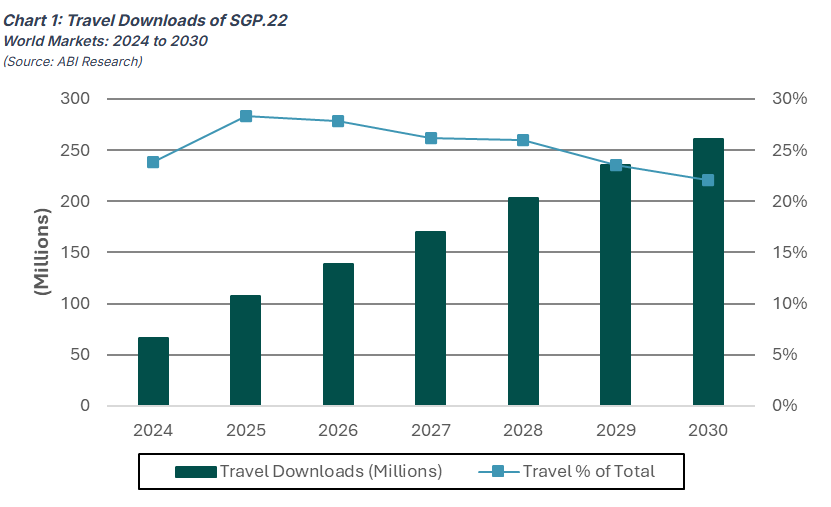
According to ABI Research, travel eSIM accounted for about a quarter of all SGP.22 consumer profile downloads last year. Travel eSIM is only used by a small portion of travelers, and eSIM support is mostly lacking outside of the Apple ecosystem. However, marketing campaigns and tailored messaging to consumers/enterprises will stimulate even greater demand for travel eSIM over the coming years.
Shipments of eSIM-only devices are expected to make a big jump in 2026 and 2027, before flattening to around 120 million units annually between 2028 and 2030. By this time, the installed base for eSIM-enabled devices will be significant worldwide, providing lucrative opportunities for vendors to target travel use cases.
Thanks to Apple, the United States dominates eSIM profile downloads to date. As Apple expands into new regions and other smartphone manufacturers support eSIM, the U.S. market share will certainly dwindle, but remain significant.
Although travel eSIM is traditionally consumer-focused, notable companies like Airalo and Mindszi offer solutions specifically for enterprises. Generally speaking, enterprises will be more brand “sticky” and offer longer-term value than consumers.
What Is Influencing Demand for Travel eSIM?
The primary factors influencing the travel eSIM shares are as follows:
- Repeat Use: Although a minority of global travelers use travel eSIM, there is a strong bias toward repeat or multiple usage, particularly among “power” users and enterprise applications. This contrasts with the limited download of secondary or alternative profiles for domestic use.
- eSIM-Only Devices: Currently, eSIM-only device penetration is limited, with the bulk of them being Apple devices from the United States.
- Degree of Activation of eSIM-Enabled—but Not eSIM-Only—Smartphones for Primary Use: Most eSIM-enabled smartphones globally are not yet activated for eSIM use, with many consumers preferring the familiar removable SIM. Outside of the eSIM-first strategy of the United States, in many cases, travel is the impetus for the first eSIM download for a consumer.
What’s the Future Outlook for the Travel eSIM Market?
Major shifts are expected to unfold through the rest of the decade, directly impacting the travel eSIM market. ABI Research forecasts the following trends:
- 2025 to 2026: Consumers and enterprises will increasingly recognize travel eSIM niches, with the share of travel downloads reaching 28% in 2026.
- 2027 to 2028: Despite strong absolute growth in the mid-term, with downloads increasing to 780.9 million in 2028, travel as a proportion of total downloads will stagnate. Travel downloads will become steadier in comparison, with a degree of penetration being reached among high-usage travelers. Major enterprise-targeting launches of 2026 and 2027 will settle into more regular download patterns.
- 2029 to 2030: Growth of travel downloads will continue, but is significantly slowed, with Year-over-Year (YoY) growth in 2030 falling just shy of 18%—compared to over 37% in 2025. However, this effect of increasing saturation of the existing market will be offset by an increased numbers of travelers owning eSIM-only devices.
Which Companies Facilitate Travel eSIM?
Airalo
As the most recognizable travel eSIM brand, Airalo holds a lot of sway in the market, and other companies often look to it for inspiration. The company provides a marketplace where users can select an operator-badged bundle in over 200 countries.
Although still the king of travel eSIM, Airalo faces external pressure from other vendors. In response, the vendor has expanded to enterprise support, reflecting the need for travel brands to diversify and reduce reliance on consumer usage.
eSIM Go
eSIM Go has roots in the telecoms industry, setting it up to be a key enabler of travel eSIM support for other brands. eSIM Go emphasizes full service, with “no hassle” deployments allowing anyone to spin up a new brand or leverage an existing brand with eSIM without risking customer trust, due to an emphasis on network quality and customer care.
eSIM Go diverges from most travel eSIM ecosystem players in that it is an enabler of the use case. While other travel brands will be competing against one another in a consolidated market, eSIM Go’s enablement solutions will be valuable to virtually any company seeking rapid deployment of travel eSIM connectivity.
Mindszi
Mindszi provides connectivity for enterprises that travel, which represents the differentiation efforts of some eSIM brands. Business-focused features include a copilot-based distribution method, private network support, and the ability to integrate into expense management software.
Mindszi’s innovative copilot-based model allows chat-based, pain-free request, approval, and activation of eSIMs through a platform with hundreds of millions of Teams users. Given the criticality of connectivity, data, and network security in the modern workforce, Mindszi has positioned itself to corner a large share of those enterprises seeking travel eSIM solutions.
RedteaGO
Being under the umbrella of the eSIM access specialty subsidiary of Redtea Mobile, RedteaGO can leverage experience and mature infrastructure, producing network quality and stability in messaging.
Available in over 150 countries, RedteaGO highlights a pain-free, reliable service with 24/7 customer support and flexible top-up options. RedteaGO’s approach exemplifies a trend that differentiates new travel brands from the subsidiaries of existing networks. That is, a simple, convenience-focused user experience that eschews the high cost of acquiring some models, while retaining customers with a core quality focus.
Get the Report: As brands race to the top of the travel eSIM market, they must account for a variety of factors that directly influence success. These factors include white labeling options, customer experience, the use of data analytics, targeting strategies, security, and regional attitudes. For a closer look at how travel eSIM is progressing and to take a deep dive into these strategic imperatives, download ABI Research’s Drivers, Challenges, and Opportunities in the Travel eSIM Market: The Factors Behind an Evolving Ecosystem.
Related Research

Report | 3Q 2025 | AN-6456
Related Service

- Competitive & Market Intelligence
- Executive & C-Suite
- Marketing
- Product Strategy
- Startup Leader & Founder
- Users & Implementers
Job Role
- Telco & Communications
- Hyperscalers
- Industrial & Manufacturing
- Semiconductor
- Supply Chain
- Industry & Trade Organizations
Industry
Services
Spotlights
5G, Cloud & Networks
- 5G Devices, Smartphones & Wearables
- 5G, 6G & Open RAN
- Data Centers
- Enterprise Connectivity
- Space Technologies & Innovation
- Telco AI
AI & Robotics
Automotive
Bluetooth, Wi-Fi & Short Range Wireless
Cyber & Digital Security
- Citizen Digital Identity
- Digital Payment Technologies
- eSIM & SIM Solutions
- Quantum Safe Technologies
- Trusted Device Solutions