
Which Telcos Are the Most Successful at Reducing Scope 3 Emissions?
Leading telco companies like Nokia, Cisco, and Ericsson are making substantial progress in curbing Scope 3 emissions. Their efforts in measurement, supplier collaboration, and R&D are driving meaningful reductions across key emissions categories. These companies' commitment to achieving net-zero emissions, combined with their focus on sustainability, sets a strong example for the industry.
Log In to unlock this content.
You have x unlocks remaining.
This content falls outside of your subscription, but you may view up to five pieces of premium content outside of your subscription each month
You have x unlocks remaining.
Scope 3 emissions are a key bottleneck in the telecommunications industry’s sustainability agenda. It’s more challenging to track the carbon footprint of transport, end-of-life products, and supplier operations. In its Telco Scope 3 Emissions Management competitive ranking, ABI Research provides an in-depth analysis of prominent players such as Nokia, Cisco, Ericsson, and Samsung. The companies that are the most effective at addressing Scope 3 emissions place a heavy emphasis on holding suppliers accountable and possess a robust means of monitoring the footprint of their supply chains. This Research Highlight shares our key findings, including the criteria we evaluated for the ranking and company profiles of the top industry players.
Innovation Criteria
The innovation criteria assess the efforts of telecom vendors in using sustainable business practices to reduce Scope 3 emissions:
- Scope 3 Measurement and Reporting: Companies ensure accurate Scope 3 emissions data by using robust methodologies and obtaining third-party verification where possible. They report all relevant Scope 3 categories to provide a comprehensive view of their emissions.
- Supplier Engagement and Collaboration: Telecom companies actively engage with their suppliers to promote transparency and sustainability. They require suppliers to set emissions reduction targets and participate in programs like the CDP Supply Chain program to drive collective action.
- Strategy Delivery and Governance: Companies establish dedicated teams or governance bodies responsible for overseeing the implementation of their net-zero strategies. They tie Scope 3 emissions goals to executive remuneration to incentivize progress toward sustainability.
- Targets: Telecom vendors set clear, measurable targets to achieve net-zero emissions. Initiatives like the Science Based Targets Initiative (SBTi) often validate these targets, which include intermediary Scope 3 emissions reduction goals to track progress.
- Research & Development (R&D): A significant portion of R&D investments is directed at improving environmental performance. This includes innovations that address Scope 3 emissions, such as developing energy-efficient products and solutions to reduce emissions across the value chain.
Top Innovators
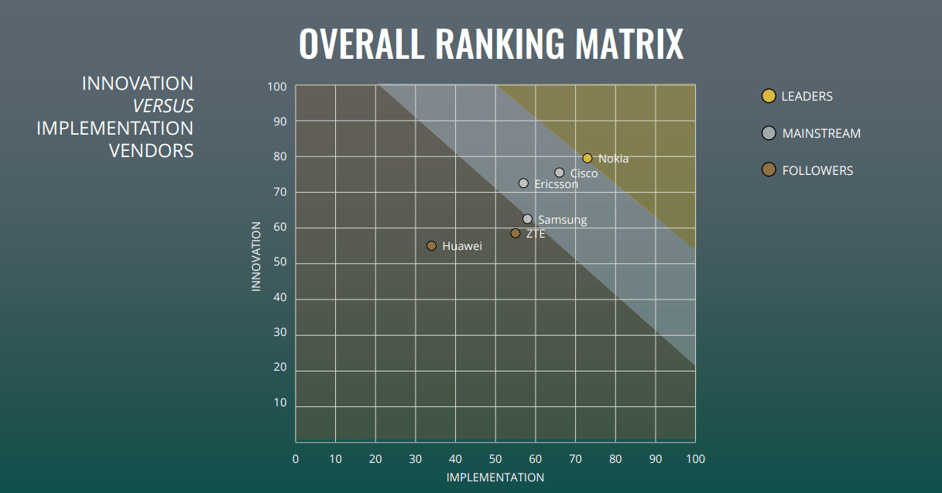
1.) Nokia (Score: 79.5)
Nokia has established a strong foundation for Scope 3 emissions reporting by working closely with suppliers to gather reliable emissions data. In 2023, 63% of its suppliers provided emissions data through the CDP Supply Chain program. Nokia's engagement with suppliers focuses on driving significant emissions reductions, with dedicated targets set for final assembly suppliers and other key suppliers. The company aims to achieve net-zero emissions across its value chain by 2040, with a 50% reduction target by 2030. Nokia’s investment in R&D for energy-efficient products, such as its AirScale Radio portfolio, further supports its ambitious sustainability goals.
2.) Cisco (Score: 75.5)
Cisco has made substantial strides in Scope 3 emissions measurement by enhancing its methodology for Scope 3 categories, ensuring accurate data for its emissions calculation. In Fiscal Year (FY) 2023, Cisco improved its Scope 3 reporting, including more precise calculations for the use phase of products. The company’s collaboration with its suppliers emphasizes setting clear emissions reduction targets. Cisco’s commitment to energy efficiency is evident in its R&D efforts, which focus on energy-saving innovations in both hardware and software. Cisco aims to reduce Scope 3 emissions by 30% by FY 2030, with a long-term net-zero emissions target by FY 2040.
3.) Ericsson (Score: 72.5)
Ericsson’s efforts to reduce Scope 3 emissions are underpinned by its focus on enhancing the accuracy of its emissions accounting. The company has worked with suppliers to help them set targets aligned with a 1.5°C climate scenario, aiming to reduce emissions by 50% by 2030. Ericsson’s governance structure ensures its sustainability goals are monitored at the highest levels, with executive compensation tied to Environmental, Social, and Governance (ESG) criteria. Ericsson’s commitment to reducing Scope 3 emissions is reinforced by its substantial investments in R&D to improve the energy performance of its network equipment and solutions.
Want more insight into how telcos are addressing their Scope 3 emissions? Connect with an ABI Research representative today to discuss how we can help your organization.
Implementation Criteria
The implementation criteria evaluate the success of telecom vendors in reducing Scope 3 emissions across key categories:
- Total Scope 3 Emissions: The Year-over-Year (YoY) change in total Scope 3 emissions is tracked to measure progress. Companies aim for significant reductions compared to their baseline emissions year.
- Purchased Goods and Services and Capital Goods: Companies report the YoY percentage change in emissions from purchased goods and services, and capital goods, aiming for significant reductions in these categories as they account for a large portion of Scope 3 emissions.
- Upstream and Downstream Transportation: Vendors track emissions from both upstream and downstream transportation, striving to reduce emissions by optimizing logistics and shifting transportation methods to more sustainable options.
- Use of Sold Products: Emissions from the use phase of products are a significant contributor to Scope 3 emissions, and companies focus on reducing energy consumption in their products through energy efficiency improvements and innovations.
- Other Emissions Categories: Companies assess emissions across other significant categories, targeting reductions where possible, and monitoring progress in these areas over time.
Top Implementers
1.) Nokia (Score: 73)
Nokia achieved a 10.8% reduction in total Scope 3 emissions in 2023, continuing its leadership in decarbonizing its operations. The company made notable progress in reducing emissions from purchased goods and services, achieving a 21% reduction in this category between 2019 and 2023. Nokia’s efforts to optimize upstream transportation resulted in a 57% reduction in emissions, while the company also made significant strides in reducing business air travel emissions. Nokia’s comprehensive supplier engagement program and its focus on material efficiency innovations have driven substantial reductions across key emissions categories.
2.) Cisco (Score: 66)
Cisco’s total Scope 3 emissions increased by 24% in FY 2023, largely due to higher product sales, but the company achieved a 16% reduction compared to its 2019 baseline. Cisco made significant progress in reducing emissions from purchased goods and services, with a 28% reduction since FY 2019. The company’s efforts to shift transportation methods from air to ocean and promote energy efficiency in the use phase have been key drivers of emissions reductions. Cisco’s work with suppliers to improve emissions tracking and reporting has also contributed to its overall progress.
3.) Samsung (Score: 58)
Samsung reduced its Scope 3 emissions by 4% between 2022 and 2023, with significant reductions in purchased goods and services (12%). The company’s focus on optimizing logistics and reducing transportation emissions has led to a 5% reduction in emissions from upstream and downstream transportation. Samsung has integrated energy-efficient technologies into its product portfolio, leading to a 16% improvement in product energy efficiency since its 2019 baseline. The company’s investments in energy-efficient chipsets and dynamic energy-saving software have contributed to lower energy consumption in its products.
Conclusion
ABI Research just published a report evaluating seven telcos on their Scope 3 emissions reduction efforts. Our analysis compares these companies’ strategies, corporate priorities, investments/partnerships, and other performance indicators. For the full assessment, download the report today.
Related Research

Competitive Ranking | 4Q 2024 | CA-1450
Related Service
- Competitive & Market Intelligence
- Executive & C-Suite
- Marketing
- Product Strategy
- Startup Leader & Founder
- Users & Implementers
Job Role
- Telco & Communications
- Hyperscalers
- Industrial & Manufacturing
- Semiconductor
- Supply Chain
- Industry & Trade Organizations
Industry
Services
Spotlights
5G, Cloud & Networks
- 5G Devices, Smartphones & Wearables
- 5G, 6G & Open RAN
- Data Centers
- Enterprise Connectivity
- Space Technologies & Innovation
- Telco AI
AI & Robotics
Automotive
Bluetooth, Wi-Fi & Short Range Wireless
Cyber & Digital Security
- Citizen Digital Identity
- Digital Payment Technologies
- eSIM & SIM Solutions
- Quantum Safe Technologies
- Trusted Device Solutions