
Are Small Modular Reactors (SMRs) Viable?
Small Modular Reactors (SMRs) will become a more viable emissions-free energy source in the coming years. SMRs are reshaping the future of clean energy by offering faster, safer, and more flexible alternatives to traditional nuclear plants. As global demand for sustainable power grows, governments and energy leaders are investing billions in SMR technology to reach net-zero goals. Learn how SMRs are driving innovation, overcoming regulatory hurdles, and setting the stage for a new era in nuclear energy.
Log In to unlock this content.
You have x unlocks remaining.
This content falls outside of your subscription, but you may view up to five pieces of premium content outside of your subscription each month
You have x unlocks remaining.
Key Takeaways:
- SMRs are key to net-zero goals. Their modular design enables faster, lower-cost clean energy for electric grids, data centers, and industrial sites.
- SMR deployments will accelerate after 2030. As regulations improve, global SMR projects are set to reach 262 units and 41.6 Gigawatts (GW) by 2040, driven by the United States, Europe, and Asia-Pacific.
- Safety and trust are essential. Vendors must prioritize strong safety design, government partnerships, efficient operations, and transparent communication.
In the quest to reach net-zero emissions, governments and enterprises have placed increased focus on Small Modular Reactors (SMRs). SMRs are revolutionizing the nuclear energy industry by offering reliable and flexible sources of renewables at a lower cost than traditional Gigawatt (GW)-scale plants. Due to their modular design, SMRs can be constructed much more quickly, accelerating the sustainability efforts.
In these early days, SMRs are providing clean energy for public grids and on the private on-site side, at data centers, green hydrogen plants, desalination operations, and industrial plants. The SMR ecosystem can be divided into three categories:
- Large established energy providers (e.g., Rolls-Royce SMR, GE Vernova Hitachi Nuclear Energy)
- National governments (China, Russia, Korea, United States)
- Nuclear energy startups (e.g., Oklo, Deep Atomic, etc.)
Dominique Bonte, Vice President of End Markets and Verticals at ABI Research, states that “While the regulators will hold the keys to the success of SMRs, it’s unlikely that a timely alternative to SMRs to meet future (clean) energy demands will present itself, with the prospects of fusion still being remote. He continues, “For most governments, going ahead with SMRs will be very tempting or deemed unavoidable in preventing economies from stalling due to energy constraints.”
Small Modular Reactor Nuclear Technologies
While water reactors are currently the most used technology for SMRs, innovative concepts based on Sodium Fast Reactors (SFRs) and Molten Salt Reactors (MSRs) are being developed by startups seeking benefits. Examples include independence from water sources and sustainability/nuclear fuel recycling advantages.
Table 1: Small Modular Reactor Technologies, Applications, and Examples
|
NUCLEAR TECHNOLOGIES |
DESCRIPTION |
TYPES/APPLICATIONS |
Examples |
|
Light Water Reactors (LWRs) |
Use of water for cooling and moderation |
Boiling Water Reactors (BWRs) Pressurized Water Reactors (PWRs) |
GVH - BWRX-300; Holtec; Rolls-Royce; Rosatom; China; NuScale Power; Westinghouse; KAERI |
|
Sodium Fast Reactors (SFRs) |
Liquid sodium as a coolant and fast neutrons for fission fuel recycling ability |
Do not require external water sources (sustainability) |
TerraPower GVH Aalo Atomics |
|
High-Temperature Gas Reactors (HTGRs) |
Use helium gas as coolant |
Wide-use industrial applications Hydrogen Generation |
China X-Energy |
|
Molten Salt Reactors (MSRs) |
Mixing liquid fuel with molten salt coolant |
Industrial process heat for chemical industries |
Moltex Energy Stellaria |
|
Liquid-Metal-Cooled, Metal-Fueled Fast Reactor (LMFRs) |
Sodium, lead, or a lead-bismuth eutectic as the coolant and uranium-plutonium-zirconium metal alloy fuels |
Breeder reactors Naval propulsion Power generation with higher thermal efficiency |
Oklo |
Related Content
Nuclear Energy Coming to Data Centers: Equinix Taps into Rolls-Royce-powered SMRs
SMR Adoption Won’t Ramp Up Until After 2030
There are just two small modular reactors in operation as of 2025: one in Russia and one in China. But that number will expand to seven by 2030 as North American and European projects come to fruition.
According to ABI Research, SMR construction projects will begin to gather momentum between 2030 and 2035, with total deployments forecast to reach 262 by 2040. The total aggregated capacity is projected to be 41.58 GW.
Some of the current hurdles to SMR development include lagging regulatory frameworks, lengthy design approvals, and permit acquisition. As the regulatory ecosystem evolves and the industry matures, these issues should gradually dissipate.
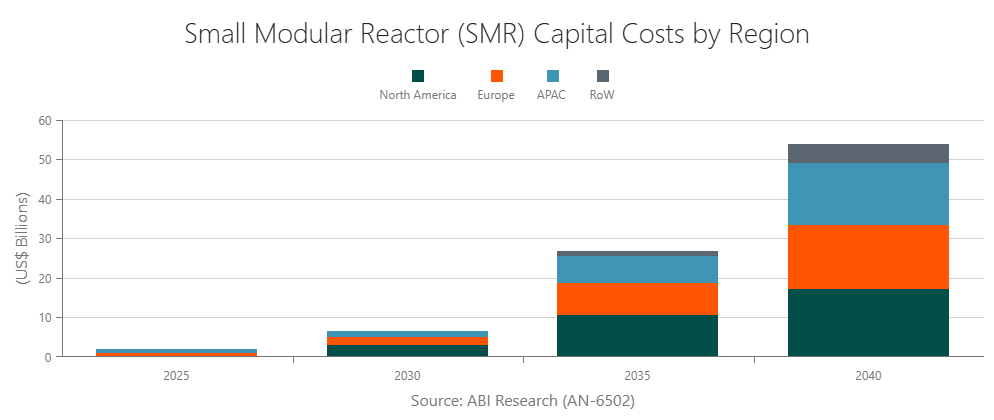
On a regional level, the top countries driving SMR construction include the United States, the United Kingdom, France, Poland, Sweden, Canada, Russia, China, and South Korea. Combined, these countries are projected to sink more than US$320 billion in cumulative Capital Expenditure (CAPEX) by 2040.
North America will lead the way with US$17.2 billion in SMR CAPEX in 2040, followed by Europe (US$16.2 billion), Asia-Pacific (US$15.6 billion), and Rest of World (RoW) (US$4.8 billion).
What Should Nuclear Energy Technology Vendors and Stakeholders Do?
If the nuclear energy industry is to mature, vendors must account for a variety of challenges and stakeholders. Safety concerns, government collaboration, operational excellence, and public perception are key factors for nuclear energy vendors to act on. Bonte provides the following recommendations:
- Do Not Compromise on Safety: SMRs need to be designed with passive and active safety features as the absolute number 1 priority from both a technology design and operational procedures perspective; this includes decommissioning safety aspects.
- Work Closely with Governments: Not just complying with regulations, but actively partnering and cooperating on innovative technological approaches.
- Support Operational Excellence: Design for maximum ease of deployment and maintenance at low-cost levels to deliver on SMRs’ promise of agile and versatile nuclear technology; develop optimized suites of digital applications for plant design, configuration, control, and operation. Example: “Network Operating System (NOS) Artificial Intelligence (AI)-driven, real-time software system for nuclear construction” (Palantir and the Nuclear Company).
- Manage Public Opinion: This consists of high levels of transparency, education, and awareness, as well as cooperation with representatives of citizens' associations.
Download the Report
Download ABI Research’s report, Small Modular Reactors (SMRs) – Technologies, Applications, and Use Cases, to learn how SMRs are redefining the energy sector.
Companies Mentioned: China National Nuclear Corporation (CNNC), Rosatom, NuScale Power, GE Vernova Hitachi Nuclear Energy (GVH), Holtec, Rolls-Royce, TerraPower, Westinghouse Electric Company, X-energy, Korea Atomic Energy Research Institute (KAERI), Oklo, Aolo Atomics/Idaho National Laboratory, Moltex Energy, Stellaria, and Deep Atomic.
Gain tech advisory for SMR deployments, investments, and market outlook by subscribing to ABI Research’s Smart Energy Research Service.
Frequently Asked Questions
Are small modular reactors viable?
Yes, SMRs are becoming a practical clean energy solution. Their modular design allows faster, safer, and lower-cost deployment than traditional nuclear plants. However, wider adoption depends on streamlined regulations and public trust.
What is the outlook for small modular reactors?
The outlook for Small Modular Reactors (SMRs) is strong, with global projects expected to expand rapidly after 2030. ABI Research forecasts 262 SMR units and 41.6 GW of capacity by 2040, driven by investments from the United States, Europe, and Asia-Pacific.
Do small modular reactors use uranium?
Yes, most SMR designs are fueled by enriched uranium, namely Uranium Dioxide (UO2) enriched to 3% to 5% U-235. Other fuel types include mixed oxide fuels, thorium-based fuels, Uranium-Zirconium (U-Zr), Uranium-Plutonium-Zirconium (U-Pu-Zr), and liquid salt fuels.
How much does a small modular reactor cost?
The Capital Expenditure (CAPEX) for small modular reactors is about US$1 billion, which is significantly cheaper than microreactors and nuclear reactors. The Operational Expenditure (OPEX) is at a medium level.
Related Research

Report | 4Q 2025 | AN-6502
Related Service

- Competitive & Market Intelligence
- Executive & C-Suite
- Marketing
- Product Strategy
- Startup Leader & Founder
- Users & Implementers
Job Role
- Telco & Communications
- Hyperscalers
- Industrial & Manufacturing
- Semiconductor
- Supply Chain
- Industry & Trade Organizations
Industry
Services
Spotlights
5G, Cloud & Networks
- 5G Devices, Smartphones & Wearables
- 5G, 6G & Open RAN
- Data Centers
- Enterprise Connectivity
- Space Technologies & Innovation
- Telco AI
AI & Robotics
Automotive
Bluetooth, Wi-Fi & Short Range Wireless
Cyber & Digital Security
- Citizen Digital Identity
- Digital Payment Technologies
- eSIM & SIM Solutions
- Quantum Safe Technologies
- Trusted Device Solutions