
Alternative Payment Methods (APMs): Key Implementation Strategies for Payment Providers
Leveraging ABI Research’s application analysis report, this Research Highlight delves into the transformative growth of Alternative Payment Methods (APMs)—QR payments, instant payments, digital wallets, and Central Bank Digital Currencies (CBDCs). As global payment systems pivot to digitally-driven solutions, decision makers in APM companies, governments, and regulatory bodies must strategically address financial inclusion, security, and market needs to capitalize on this shift.
Log In to unlock this content.
You have x unlocks remaining.
This content falls outside of your subscription, but you may view up to five pieces of premium content outside of your subscription each month
You have x unlocks remaining.
Alternative Payment Method (APM) Market Overview
Alternative Payment Methods (APMs), encompassing QR payments, instant payments, digital wallets, and Central Bank Digital Currencies (CBDCs), are revolutionizing global payment ecosystems. Indeed, they are surpassing traditional transaction methods like cash and credit cards. Domestic Payment Methods (DPMs), within the category of APMs, are gaining momentum by offering enhanced consumer experiences through super apps and fostering interoperability across markets.
In cash-to-digital economies like Brazil, Russia, India, China, and South Africa (BRICS), QR payments are expanding rapidly. At the forefront of the most popular DPMs are Brazil’s Pix and China’s WeChat. Conversely, in North America and Europe, QR adoption remains limited to niche use cases like hospitality and charity due to security concerns and widespread mobile Point of Sale (POS) systems.
Some key stats and trends to know about APMs are below:
- DPMs powered two-thirds of global online payments, a significant jump from 25% in 2010.
- Over 90% of central banks are exploring CBDCs to bolster financial sovereignty via digital wallets.
- A 2023 U.S. Federal Reserve study highlights that 86% of businesses and 74% of consumers prefer instant payments for their convenience and speed.
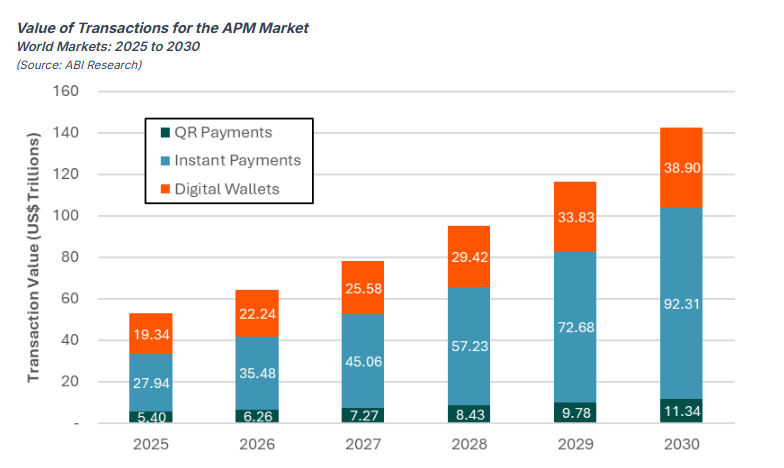
- ABI Research forecasts that the total combined global value of transactions for the APM market will reach US$52.68 trillion by the end of 2025. APM transactions will be led by instant payments (45%), digital wallets (41%), and QR payments (14%).
Strategies for Implementing Instant Payments
- Serving Underbanked Populations: APM decision makers must champion financial inclusion in cash-dominated markets by deploying instant payment systems like Unified Payments Interface (UPI), which allows unbanked users to transact using account IDs instead of bank routing numbers. Such a case can broaden e-commerce access to more citizens.
- Securing Banking Data: APM offerings must have security guarantees at least on par with traditional payment methods. As a good example, Brazil’s Pix encrypts transactions within the isolated National Financial System Network (RSFN), requiring security certificates to minimize fraud risks.
- Emphasize Around-the-Clock Availability of Funds: Marketing the 24/7 availability of instant payments is also key; a European Central Bank report notes a 50% reduction in liquidity risks, improving cash flow and operational efficiency for businesses. Governments and companies should highlight these advantages to drive adoption, ensuring that APM systems are user-friendly and accessible to diverse populations, including those without traditional banking access.
Strategies for Implementing Digital Wallets
- Go Beyond Payment Functionality: APM innovation leaders must transform digital wallets into comprehensive platforms that extend beyond payments. Incorporating services like insurance, automated bill payments, and financial reconciliation, as seen with GoPay in Indonesia, will attract more customers and businesses.
- Leverage the Appeal of Mobile: A 2024 ABI Research survey reveals that 82% of consumers use smartphones or smartwatches for contactless payments. This underscores the need to leverage device security features like embedded Secure Elements (eSEs) and Multi-Factor Authentication (MFA) (e.g., fingerprint or facial recognition) to build trust.
- Create Application Versatility: Integrating instant payment systems ensures seamless peer-to-peer transfers, while Application Programming Interfaces (APIs) can streamline bookkeeping and inventory management, appealing to businesses seeking operational agility. Emphasizing digital wallets’ versatility for both online and in-store purchases, as evidenced by their 50% share of 2023 global e-commerce transactions per Worldpay, will further accelerate the adoption of this APM.
Strategies for Implementing QR Payments
- Market QR’s Streamlining Payment Capabilities: APM providers should promote QR payments’ speed and cost-effectiveness, particularly in cash-heavy regions.
- Integrate with Digital Wallets or Community Platforms: Integrating QR payment codes into digital wallets or community platforms like WeChat Pay, which offers real-time customer engagement and promotions, enhances user experience and fosters brand loyalty.
- Ease Security Concerns: In Western markets, addressing security concerns is critical—adopting Asia-Pacific’s robust measures, such as WeChat Pay’s real-time fraud monitoring and stringent data protection, can counter perceptions of vulnerabilities like “quishing” (QR code phishing).
- Promote Interoperability for Cross-Border Transactions: APM technology providers must leverage local currency capabilities for competitive exchange rates. This positions QR payments as a scalable, low-cost option. Increased regulation and international standardization will further bolster public confidence and drive adoption.
Key Companies
Across the APM ecosystem, there are several standout companies that can be used as great use cases for organizations looking to develop or deploy APM into their domestic market.
- Pix (Brazil)
- WeChat (China)
- UPI (India)
- GoPaY (Indonesia)
Learn More About How APMs Are Reshaping the Financial Industry
For a comprehensive study of APM implementation strategies, market trends, demand forecasts, and vendor analyses, download ABI Research’s application analysis report, The Rise of Domestic Alternate Payment Systems.
Related Research

Report | 1Q 2025 | AN-6335
Related Service

- Competitive & Market Intelligence
- Executive & C-Suite
- Marketing
- Product Strategy
- Startup Leader & Founder
- Users & Implementers
Job Role
- Telco & Communications
- Hyperscalers
- Industrial & Manufacturing
- Semiconductor
- Supply Chain
- Industry & Trade Organizations
Industry
Services
Spotlights
5G, Cloud & Networks
- 5G Devices, Smartphones & Wearables
- 5G, 6G & Open RAN
- Data Centers
- Enterprise Connectivity
- Space Technologies & Innovation
- Telco AI
AI & Robotics
Automotive
Bluetooth, Wi-Fi & Short Range Wireless
Cyber & Digital Security
- Citizen Digital Identity
- Digital Payment Technologies
- eSIM & SIM Solutions
- Quantum Safe Technologies
- Trusted Device Solutions