
SOURCE RESEARCH
Exoskeletons
Market Data | 3Q 2025 | MD-XROBO-103
Get The ReportKey Findings
Below lists the key trends identified in ABI Research's exoskeleton market forecast.
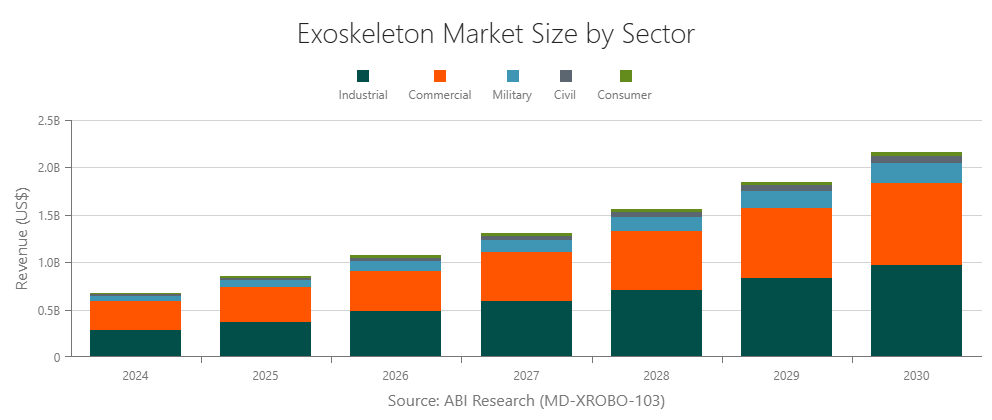
- The Exoskeleton Market Size Will Grow by 254%: Between 2025 and 2030, worldwide revenue for exoskeletons will increase from US$850 million to more than US$2 billion.
- Industrial and Commercial Segments Dominate: The industrial and commercials segments account for ~85% of the market throughout the forecast window, with near parit revenue projections.
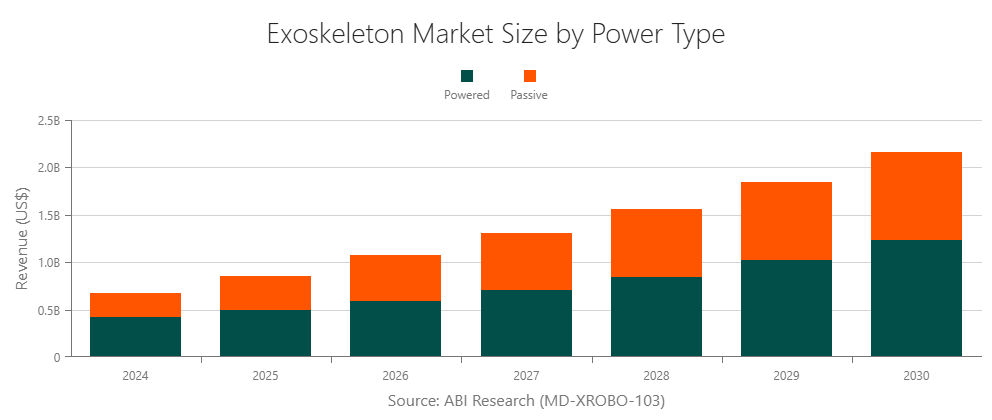
- Powered Exoskeletons Drive Most Market Revenue: Powered exoskeletons account for more than 2X as much revenue as passive ones.
- Most Revenue Comes from Asia: The Asia-Pacific region generates 46% of global exoskeleton revenue in 2025, with that number projected to increase to 53% by 2030.
With a Compound Annual Growth Rate (CAGR) of 21.4%, the exoskeleton market size will increase from US$850 million in 2025 to US$2.2 billion in 2030. The market will be led by Asian manufacturing hubs China, Japan, and South Korea. Joining them include Germany and the United States.
The market share for each country/region as of 2025 is listed below:
- United States (20%)
- Japan (19%)
- China (13%)
- Germany (14%)
- South Korea (8%)
- Rest of World (26%)
By 2030, ABI Research forecasts these market shares to revise to:
- United States (16%)
- China (16%)
- Japan (13%)
- Germany (12%)
- South Korea (13%)
- Rest of World (30%)
As the chart below shows, the industrial sector will lead the exoskeleton market. Exoskeletons are used to augment workers handling strenuous tasks, such as lifting heavy equipment. it helps manufacturers and other industrial firms avoid worker injuries, reducing costs of disability payouts.
Our market update also studies the revenue opportunity for powered (active) exoskeletons versus passive exoskeletons. The former are battery-powered and motorized, capable of more robust applications. With that, comes higher ASPs and more revenue. Passive exoskeletons are more lightweight and will see more shipments, but less revenue.
Methodology
This market data forecast is designed to provide a comprehensive understanding of ABI Research’s expectations of this nascent market. The revenue figures were calculated by multiplying unit sizes with the average sales price. A Compound Average Growth Rate (CAGR) analysis has been added. The exoskeleton market is broken down into a number of specific categories, namely powered/unpowered, body type, lift, market, and regional breakdown.
Powered/Passive
Unpowered refers to exoskeletons that require no power source, batteries, motors, or mechatronics. Powered exoskeletons have a power source and will have enhanced capability, but require charging.
Unpowered exoskeletons can be used to enable improved body posture, alleviate pain, and rehabilitate the injured. If the goal is to augment human strength or endurance, there is greater need for powered exosuits. Though more capable, powered (or active) exoskeletons are considerably more expensive.
Body Type
- Lower Body: Capable of being used for assistive and rehabilitative purposes
- Upper Body: Tend to be used to assist the wearer and amplify human capability
- Full Body: Full exosuits that cover the upper and lower body; generally, more sophisticated and expensive
Lift/Payload (Applies Exclusively to Powered Exoskeletons)
- Light Lift: Payload of 0 to 25 Pounds (lbs.) (0 to 11 Kilograms (kg))
- Medium Lift: Payload of 25 to 75 lbs. (11 to 34 kg)
- Heavy Lift: Payload of 75 lbs. + (34+ kg)
* While lower body exoskeletons are often not designed to help lift an object, they have a maximum load support. This is counted as payload.
Industrial
Exoskeletons are a key technology enabler associated with the so-called Industry 4.0, alongside modern robotics, the Industrial Internet of Things (IIoT), and Artificial Intelligence (AI). As connected devices that enhance worker productivity and provide actionable employee intelligence, they are a vital force-multiplier for the future industrial workforce.
- Mining: For use in mining operations and extraction
- Agriculture: For farm laborers
- Construction: Improving worker capability and avoiding injury in dynamic unstructured environments
- Oil & Gas: Use in oil rigs, oil fields, refining, and logistics
- Energy and Utilities: Nuclear, coal, wind & solar, and the national grid
- Aerospace Manufacturing: Exosuits used for production of aircraft and high-end products
- Automobile Manufacturing: For use on the production line in the automobile industry
- Manufacturing (other): Heavy metals, electronics, process, food manufacturing, etc.
Commercial (Including Health)
With North America, Europe, and East Asia all dealing with aging populations, there is huge potential in the promise of exoskeletons to mitigate injuries and disability, and to eventually augment human capability.
- Health: Rehabilitation, enablement, and ambulation; the single largest use case.
- Warehouse Logistics: One of the biggest use cases, first responder/emergency devices, will be in this by end of the year (a new product, an optimized Cray-X for outdoor environments).
- Other: Freight, services, etc.
Military
Interest in the capacity of exoskeleton technology began in the military, with the goal of significantly augmenting the capabilities of American soldiers during the Cold War. Though the reality has not, so far, matched the promise, there is increased interest from the U.S. military in deploying exoskeletons, both for general work and frontline combat.
- Intelligence, Surveillance, and Reconnaissance (ISR): Used by ISR teams
- Combat: Used to augment soldiers in frontline combat roles and by special forces
- Logistics: Used within logistics operations
- Repair: Used by motor pool teams to repair military vehicles
- Medical: Used for providing medical assistance to injured personnel
- Chemical, Biological, Radiological, and Nuclear (CBRN): CBRN operations
Civil
Many civil or public occupations involve similar work as the military or in the industrial workspace. For example, law enforcement will increasingly use exoskeletons to enable improved movement and to carry additional equipment, while maintaining physical performance.
- First Responder: Enabling persons with specialized training who are among the first to arrive and provide assistance at the scene of an emergency
- Emergency Services: Suits targeted to fire departments, search & rescue, etc.
- Law Enforcement: For officers involved in patrolling, crime-fighting, SWAT team actions, and counter-terrorism
- Private Security: Enabling and empowering private security personnel
- Environment: Conservation, preservation, forestry, etc.
- Public Safety: Sewage, road safety, public utilities
Consumer
Given the stage in the exoskeleton market, the consumer industry is a minute part of the market. Consumer-class exoskeletons are still in the research and early prototype phase. Further development and testing are required to validate the market viability of consumer exoskeleton technologies. Commercial viability is unproven as of yet. Issues related to pricing, value, robustness, usability, and more are unresolved.
- Personal Enablement/Rehabilitation: Enabling people in the home and leisure activities; for example, using exoskeletons to ski after an injury
- Personal Enhancement/Amplification: Buying exoskeletons to improve personal strength or to improve sporting performance
Regions
The various regions described in the study include the following:
- North America (United States and Canada)
- Europe (includes Russia)
- Asia-Pacific (includes Australia and New Zealand)
- Rest of World (ROW) (Middle East and Latin America)
Related Research

Exoskeleton: Annual Update
Presentation | 3Q 2020 | PT-2343

Industrial Robots
Market Data | 4Q 2024 | MD-IROBO-105
Collaborative Robots
Market Data | 4Q 2024 | MD-COBOT-102
Industrial Autonomous Material Handling Market Tracker
Market Data | 4Q 2020 | MD-IAMT-101
Collaborative and Industrial Robotics
Market Data | 2Q 2021 | MD-CAIROBO-101