
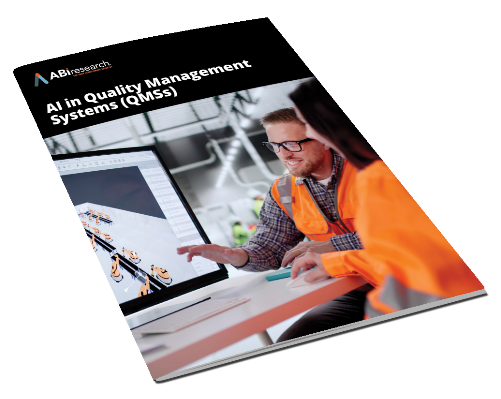

Actionable Benefits
- Understand how Artificial Intelligence (AI) is shifting from a premium Quality Management System (QMS) feature to a baseline requirement for new implementations and long-term vendor competitiveness.
- Evaluate how Agentic AI, Human-in-the-Loop (HITL) requirements, and regulatory constraints will shape automation strategies for QMSs.
- Prepare for predictive quality adoption by understanding how connected factory data, time series analysis, and AI-powered data cleaning can reduce non-conformance and post-production quality events.

Research Highlights
- Forecast of AI-attributable revenue in QMSs from 2025 to 2035.
- Evaluation of HITL as the central barrier to agentic QMS autonomy, with analysis of ISO 9001:2026, European Union (EU) AI Act Annex 22, Food & Drug Administration (FDA) warning activity, and manufacturer trust.
- Market segmentation of QMS providers across three taxonomies: point solution providers, digital thread powerhouses, and life sciences specialists.

Critical Questions Answered
- How much of future QMS revenue will be attributable to AI and AI-related services, and why is AI becoming a base requirement for QMS implementations?
- How are ISO 9001:2026, regional regulations, and manufacturer trust concerns shaping AI governance and verification requirements in QMSs?
- How will AI accelerate consolidation across QMS-adjacent software categories while also increasing pressure for open, interoperable industrial software ecosystems?

Who Should Read This?
- QMS product leaders and strategy teams evaluating how AI, agentic workflows, HITL design, and predictive quality will reshape product roadmaps and competitive differentiation.
- Industrial software vendors, Product Lifecycle Management (PLM) providers, Manufacturing Execution System (MES) suppliers, and digital thread platform teams assessing how QMS integration, knowledge graphs, and interoperability affect broader manufacturing software strategies.
- Cloud, infrastructure, and platform providers positioning sovereign data, AI trust layers, and secure hosting capabilities for QMS vendors and regulated manufacturers.
Companies Mentioned








Related Insights

Acquisition of TQS Integration Expands Cognizant’s Ability to Help Life Sciences Firms to Run on Data
Insight | 3Q 2021 | IN-6251

Major GE Vernova & PTC Assets Threaten Incumbent Providers with New Velotic Spinout
Insight | 1Q 2026 | IN-8088
Related Research

MES Software: Discrete Manufacturing
Competitive Ranking | 4Q 2026 | CA-1620

AI in Manufacturing Execution System (MES) Software: Key Use Cases & Market Leaders
Report | 3Q 2026 | AN-6598

Generative AI Use Cases from Hannover Messe 2024
Presentation | 2Q 2024 | PT-2911