
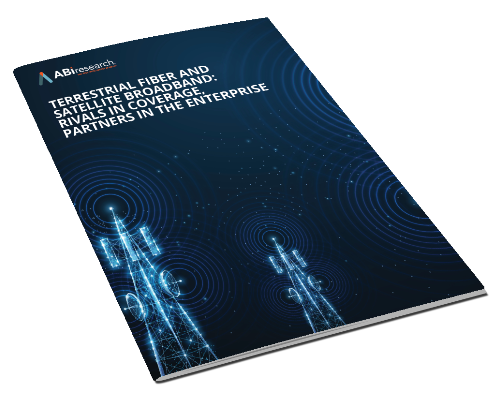

Actionable Benefits
- Understand how telcos and Managed Service Providers (MSPs) are productizing hybrid connectivity solutions for the enterprise market.
- Identify which enterprise verticals stand to gain the most from converged solutions.
- Understand where the standards sit versus the market and gaps in orchestration and chipset/terminal landscape.
- Identify the key players in the hybrid connectivity value chain.

Research Highlights
- Enterprise hybrid solutions forecast.
- Detailed comparison of terrestrial fiber, cellular, and satellite connectivity models, plus the buying models, target markets, and per-connection economics behind each.
- Coverage of The 3rd Generation Partnership Project (3GPP) NTN roadmap (Rel-17 through Rel-20), MEF 70.x Software-Defined Wide Area Network (SD-WAN) attributes, and the key satellite, telco, Network Equipment Vendor (NEV), and chipset players driving convergence.

Critical Questions Answered
- How are hybrid solutions being productized today and how are they changing?
- What is the realistic timeline for New Radio Non-Terrestrial Network (NR-NTN) broadband chipsets and network-side Access Traffic Steering, Switching, and Splitting (ATSSS) implementations to reach commercial availability?
- Which verticals stand to gain most from hybrid satellite + cellular/Wi-Fi access, and where does the Return on Investment (ROI) case hold up?
- How are telcos positioning managed hybrid connectivity today, and who owns the convergence layer?
- What is the market opportunity for enterprise hybrid connectivity solutions?

Who Should Read This?
- Telco and Internet Service Provider (ISP) strategists deciding whether to launch managed hybrid connectivity and how to package it as a unified multi-access service.
- Satellite operators and NEV product managers aligning constellation, orchestration, and ATSSS/NTN roadmaps with enterprise Service-Level Agreement (SLA) and security requirements.
- Enterprise and vertical planners in downtime-sensitive industries evaluating satellite backhaul, private networking, and on-premises edge compute options.
Companies Mentioned




Related Insights

MWC Barcelona 2026 Space Sector Announcements: Will Direct-to-Cellular (D2C) Lead the Next Connectivity Wave?
Insight | 1Q 2026 | IN-8083

Are GEO Space Networks Dead? The LEO Takeover Shaking Up the Telecoms Industry
Insight | 1Q 2025 | IN-7727

Chinese Satellite and Smartphone Firms Prepare for Satellite NTN Market Launch
Insight | 1Q 2024 | IN-7206
Related Research

State of LEO Satellite Networks
Presentation | 1Q 2025 | PT-3560

Software-Defined NTN: Architecting the Space Backbone of Unified Networks
Report | 2Q 2025 | AN-6045

Satellite Communications: Enabling Universal Broadband Connectivity
Whitepaper | 4Q 2021 | WP-WNGH-188