
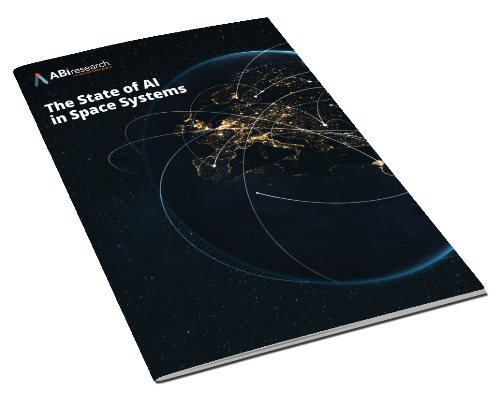

Actionable Benefits
- Understand how increasing onboard compute performance is shifting satellite Artificial Intelligence (AI) from narrow task classifiers toward foundation models, Vision-Language Models (VLMs), Large Language Models (LLMs), and Orbital Data Center (ODC) business models.
- Identify which onboard AI applications are commercially viable today across defense, maritime, agriculture, insurance, climate, telecommunications, and research verticals based on deployments with on-orbit evidence.
- Evaluate go-to-market routes for space AI hardware, software, and model vendors, including hosted compute hubs, operator design-ins, defense programs, and hyperscaler partnerships.
- Compare the strategic positions of silicon vendors, board and Digital Processing Unit (DPU) suppliers, mission service providers, satellite operators, defense primes, and hyperscalers in the emerging orbital AI supply chain.

Research Highlights
- Forecasts of AI-equipped satellites in orbit by segment from 2025 to 2030, including ODCs, defense and government programs, mission service providers, and commercial Earth Observation (EO) and Radio Frequency (RF) operators.
- Analysis of the onboard AI compute from 2020 to 2027, mapping TOPS per satellite to workload evolution.
- Assessment of key silicon vendors supporting space AI.
- Evaluation of edge-compute board and DPU vendors as the market converges.
- Overview of mission service provider and hosted-compute platforms and their role in enabling multi-tenant AI payloads and Over-the-Air (OTA) model deployment.

Critical Questions Answered
- How quickly is onboard satellite compute capacity increasing, and what new AI workload classes are enabled as Tera Operations per Second (TOPS) per satellite increase?
- Which satellite AI applications have operational evidence today, and which remain demonstrations or planned deployments?
- How are mission service providers and hosted compute platforms changing the route to market for AI software, model, silicon, and board vendors?
- Which parts of the space AI supply chain are commoditizing, and where can vendors still differentiate?
- What role will hyperscalers and terrestrial AI model vendors play in orbital AI?
- Which vertical markets are paying for onboard AI today, and how do latency reduction, downlink savings, and autonomous tasking shape commercial value?

Who Should Read This?
- Satellite operator strategy, product, and engineering leaders evaluating onboard AI.
- Silicon, accelerator, Field Programmable Gate Array (FPGA), and edge AI chipset vendors assessing flight heritage requirements, Commercial Off-the-Shelf (COTS) qualification strategies, radiation data needs, and design-in opportunities across commercial and defense satellites.
- Space compute board, DPU, and payload hardware vendors looking to differentiate.
- AI software Independent Software Vendors (ISVs) and model vendors seeking practical routes into orbit.
- Defense primes, government space agencies, and national security space program teams tracking onboard processing, BMC3 edge compute, kill-chain compression, and fire control-grade autonomy requirements.
Companies Mentioned










Related Insights

Asia Pacific Space Community Council 2024: Going Beyond Communications
Insight | 4Q 2024 | IN-7609
Are GEO Space Networks Dead? The LEO Takeover Shaking Up the Telecoms Industry
Insight | 1Q 2025 | IN-7727

Rising Stars: How Asia-Pacific Is Shaping the Future of Space Technologies
Insight | 3Q 2025 | IN-7939
Related Research

Orbital Data Centers Economics Outlook
Market Data | 2Q 2026 | MD-ODC-101

State of LEO Satellite Networks
Presentation | 1Q 2025 | PT-3560

Orbital Data Center Deployments
Market Data | 2Q 2026 | MD-SATODC-101