
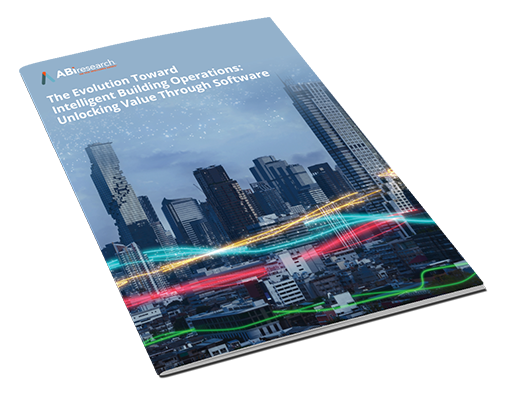

Actionable Benefits
- Understand how smart building software is shifting from passive dashboards to active operational decision-making layers that automate routine building operations.
- Evaluate the revenue opportunity from advancing connected commercial buildings toward integrated and intelligent Artificial Intelligence (AI)-enabled operations through 2035.
- Compare software maturity levels across standalone, connected-but-siloed, integrated, and intelligent operations to assess where buildings can progress next.
- Assess how fragmented data, proprietary protocols, legacy infrastructure, and organizational silos affect smart building software adoption and deployment timelines.

Research Highlights
- Forecasts of software-addressable commercial buildings by vertical from 2025 to 2035.
- Assessment of Heating, Ventilation, and Air Conditioning (HVAC) and energy optimization, environmental monitoring, life and fire safety, video analytics and detection, access and security management, and lighting and occupancy software use cases.
- Examination of how machine learning, physics-based models, Agentic AI, and human-supervised autonomy are reshaping operational intelligence in software-defined buildings.
- Evaluation of evolving Software-as-a-Service (SaaS), consumption-based, and outcome-based commercial models, and the verification capabilities required to tie pricing to operational performance.

Critical Questions Answered
- Which commercial building software use cases and maturity levels will drive the strongest growth in addressable buildings and annual recurring revenue through 2035?
- How should vendors design future-proof smart building software architectures as AI models, cloud services, and software frameworks evolve faster than building lifecycles?
- How are commercial models evolving as customers demand pricing tied to software consumption, operational scale, and measurable business outcomes?
- What organizational, procurement, cybersecurity, data standardization, and retrofit challenges are slowing adoption of integrated and intelligent smart building software?

Who Should Read This?
- Smart building software vendors and product strategists deciding how to position platforms around interoperability, workflow automation, AI-enabled operations, and measurable business outcomes.
- Building automation providers and controls manufacturers assessing how open software platforms, AI-first vendors, and hardware-agnostic solutions are reshaping competitive advantage.
- Commercial real estate owners, portfolio operators, and facilities executives evaluating how to progress connected buildings toward integrated and intelligent operations.
- Enterprise workplace software, Integrated Workplace Management System (IWMS), and facilities management platform teams evaluating opportunities to own workflows above the building layer and integrate with operational systems.
Companies Mentioned








Related Insights

AfricaCom 2025: Africa’s Transition to AI-Native Telecommunications
Insight | 1Q 2026 | IN-7999

The Role of Automation in Telcos
Insight | 1Q 2021 | IN-6071
Embedding Automation in Impeding 5G Core Deployments and Operations
Insight | 2Q 2020 | IN-5824
Related Research

Smart Buildings Semiannual Update: 1H 2026
Presentation | 3Q 2026 | PT-3861

Roadmap to Autonomous Building Operations
Presentation | 3Q 2025 | PT-6032

AI and Operations Automation in 5G Networks
Report | 4Q 2020 | AN-4903