
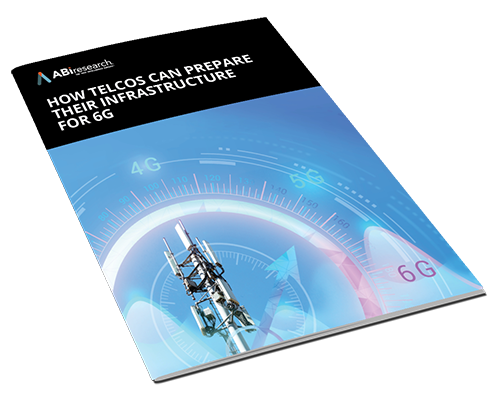

Actionable Benefits
- Understand which parts of today’s 5G-Advanced infrastructure will carry forward into 6G, enabling operators to prioritize upgrades rather than full hardware replacement.
- Identify investment priorities across cloud-native Radio Access Network (RAN), multi-layer spectrum planning, distributed compute, and energy-efficient architectures.
- Align procurement and site design with WRC-27 spectrum outcomes and the expected rise of Artificial Intelligence (AI)-native workloads.

Research Highlights
- Analysis of cloud-native RAN migration and systems integration requirements.
- Evaluation of multi-layer spectrum architecture and pre-WRC-27 investment strategy.
- Insights into backward compatibility and phased 6G migration.
- Assessment of distributed compute, edge densification, and energy-efficiency constraints.
- Review of vendor strategies across RAN, compute, and AI-native infrastructure.

Critical Questions Answered
- What infrastructure decisions must operators make before 6G standards finalize?
- How will upper mid-band spectrum and multi-layer architectures shape radio, antenna, and site requirements?
- What role will cloud-native RAN, distributed compute, and AI-native workloads play in early 6G readiness?
- How should operators balance telco-owned versus hyperscaler-based compute models?

Who Should Read This?
- Telco operators and network planners defining long-term upgrade strategies.
- Vendors and ecosystem players aligning with 6G standards and technology trends.
- Policymakers and regulators shaping spectrum strategy and national infrastructure plans.
Companies Mentioned








Related Insights

Hyperscalers Tap Neoclouds to Run Internal AI Workloads
Insight | 3Q 2025 | IN-7935

From Petro Capital to Data Capital: The Gulf States' Strategic Pivot Toward AI and Next-Generation Data Centers
Insight | 2Q 2025 | IN-7826

What the OCUDU Ecosystem Foundation Means for Telecoms Industry Sovereignty and the Future of Open Networks
Insight | 2Q 2026 | IN-8159
Related Research

6G Deployment Scenarios: From a Simple Radio Upgrade to Distributed AI Infrastructure
Presentation | 3Q 2026 | PT-4020

Green Urban Infrastructure
Presentation | 4Q 2022 | PT-2628

Smart Urban Infrastructure: Q4 2022
Presentation | 4Q 2022 | PT-2690