
Are AI Cloud Operators Fit to Run Their Own Data Centers?
 By Leo Gergs |
12 Nov 2026 |
IN-8355
Log In to unlock this content.
You have x unlocks remaining.
This content falls outside of your subscription, but you may view up to five pieces of premium content outside of your subscription each month
You have x unlocks remaining.
By Leo Gergs |
12 Nov 2026 |
IN-8355
NEWSFour Deals Reshape AI Data Center Ownership |
Four developments since late September show that control of power and of the customer now decides who owns the data center. On October 18, Microsoft dropped its anchor role at Nscale's 50 Megawatt (MW) Loughton campus after the grid operator said power would not arrive until the 2030s, only weeks after Nscale raised US$3.36 billion ahead of a planned listing. On November 6, Crusoe confirmed that Google had bought its Wyoming site to build a US$17 billion campus itself, after Crusoe reportedly failed to sign customers. Days later, Anthropic was reported to have agreed to pay US$3.4 billion for 1.7 Gigawatts (GW) of gas-fired generators, a shift for a company that had previously leased its energy capacity. Vultr, meanwhile, kept opening regions, including Chennai with 20 MW of AMD Graphics Processing Units (GPUs), and in Ohio it leases its Springfield site from a developer rather than building it. This makes you wonder whether the AI cloud (also known as neocloud) model is quietly being reversed. Two well-funded developers lost sites or tenants to the customers they were meant to serve, while an Artificial Intelligence (AI) lab chose to own its power outright. The real question may be not whether AI cloud operators can run a data center, but whether they should be the ones building it.
IMPACTGrid Access Now Outweighs GPUs |
The four cases can be arranged along a single axis, namely how much of the development stack each operator attempts to own, and when they are arranged this way, a clear pattern emerges. The more layers an operator takes on without securing power and a customer first, the greater the risk that the project slips or changes hands.
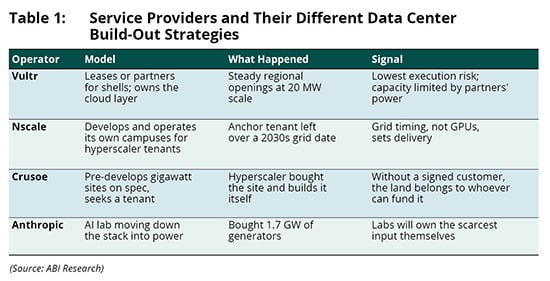
For most of the past 3 years, access to NVIDIA hardware determined who could sell AI compute, but power has now replaced chips as the gating asset. Loughton failed on a grid connection date rather than a GPU allocation, and Anthropic paid a premium to bypass generator and turbine queues reported to stretch up to 6 years. The practical consequence for AI cloud buyers and investors is that an operator's real capacity should be measured in energized megawatts, because announced gigawatts say little about what can be delivered and when.
Microsoft and Google continue to rely on AI clouds because they offer speed, and neither has abandoned its partners outright; Microsoft still works with Nscale in Texas, and Crusoe still builds for Google in Amarillo. Yet both have demonstrated, within the space of 3 weeks, that they will exit a site or absorb it when schedule, cost, or power falls short. In effect, an AI cloud's anchor contract behaves less like a firm commitment and more like an option the buyer can walk away from, which is a materially weaker position than many investor presentations imply.
Current valuations assume a development skill that few operators have yet proven. Crusoe raised capital at a US$30.9 billion valuation, and Nscale is reported to be targeting a listing near US$35 billion; both figures rest largely on pipelines measured in gigawatts. A pipeline, however, converts into revenue only when power, permits, and a paying tenant line up at the same moment, and the past month has shown how easily any one of the three can break the chain. Behind-the-Meter (BTM) gas generation has become the fastest practical route to power at scale, which explains why Anthropic, Google in Wyoming, and others are turning to it as a bridge. The trade-off is a new set of exposures, including volatile fuel prices, heightened emissions scrutiny, and growing local resistance. Communities rejected several data center projects in the 2026 midterm elections, a reminder that local community approval, the social license to operate, is now as hard to secure as grid power itself.
RECOMMENDATIONSEach Player Plays to Its Strengths |
The answer to the question posed in the title is that it depends on each player’s capabilities. Running a data center and developing one are different jobs. Hyperscalers such as Google and Microsoft combine capital, utility experience, and their own demand, which is why Google could take over Wyoming within days; they are clearly fit to develop. AI labs like Anthropic bring large, predictable demand and now secure power directly, so they are well placed to own capacity alongside experienced builders.
AI cloud developers such as Nscale and Crusoe excel at site origination and fast deployment but can develop at scale only with an anchor tenant and a firm power date, both missing at Loughton and Wyoming. CoreWeave has the demand (a US$132.5 billion backlog, 4.6 GW contracted against 1.7 GW active, about US$9 billion of expected prepayments) but leans too heavily on hyperscaler customers. With US$46.9 billion of debt and quarterly interest of US$846 million against operating income of US$207 million, it has little room if a large customer steps back. Vultr benefits from its legacy cloud business: a 34-region footprint and broad customer base provide demand, and partnering for buildings and power suits steady regional growth.
Four factors will decide who succeeds: energized power with a credible interconnection date, diversified contracted demand, sustainable funding, and local acceptance. No path is inherently weaker; the past month has punished mismatches between ambition and capability, such as a gigawatt plan without a grid connection or a speculative site without a customer.
The headlines amount to a sorting process, much like the industry’s earlier split into developers, wholesale landlords, colocation providers, and cloud operators. We expect hyperscalers and, increasingly, the leading AI labs to bring more development in-house, with AI clouds as their preferred builders and operators, as Crusoe already is for Google in Amarillo. AI clouds should secure anchor tenants and grid dates before committing capital, diversify beyond the hyperscalers, and treat prepayments as funding; alternative hyperscalers like Vultr will compete on reach, customer relationships, and efficiency rather than owning every megawatt. Buyers and investors should judge providers on energized and contracted megawatts, not announced gigawatts.
Written by Leo Gergs
As a Research Director, Leo Gergs leads enterprise connectivity and cloud and data center research at ABI Research. His work covers enterprise drivers, use cases, and provider strategies for technologies such as private cellular, SD WAN, and Fixed Wireless Access.
He also analyzes key trends shaping the data center market, including the rise of neocloud providers, the growing importance of sovereign cloud models, and their implications for enterprise infrastructure, regulation, and workload placement.
Related Service

- Competitive & Market Intelligence
- Executive & C-Suite
- Marketing
- Product Strategy
- Startup Leader & Founder
- End Users & Implementers
Job Role
- Telco & Communications
- Hyperscalers
- Industrial & Manufacturing
- Semiconductor
- Supply Chain
- Industry & Trade Organizations
Industry
Services
Spotlights
5G, Cloud & Networks
- 5G Devices, Smartphones & Wearables
- 5G, 6G & Open RAN
- Data Centers
- Enterprise Connectivity
- Space Technologies & Innovation
- Telco AI
AI & Robotics
Automotive
Bluetooth, Wi-Fi & Short Range Wireless
Cyber & Digital Security
- Citizen Digital Identity
- Digital Payment Technologies
- eSIM & SIM Solutions
- Quantum Safe Technologies
- Trusted Device Solutions