
Impending Shutdown of Microsoft’s Dynamics 365 Guides and Remote Assist Demonstrates the XR Software and Services Sector Is Responding
 By Jake Saunders |
09 Nov 2026 |
IN-8345
Log In to unlock this content.
You have x unlocks remaining.
This content falls outside of your subscription, but you may view up to five pieces of premium content outside of your subscription each month
You have x unlocks remaining.
By Jake Saunders |
09 Nov 2026 |
IN-8345
NEWSDynamics 365 Guides and Remote Assist to Shut Down |
The Extended Reality (XR) market has picked up pace since early 2025, with several product launches from Apple’s Vision Pro in July 2024, TCL RayNeo X2, to the much-anticipated XR smart glasses from Samsung in early 2027. ABI Research’s own studies (see Augmented Reality Hardware (MD-ARHW-103)) demonstrates the shift. The number of smart glasses shipments for the enterprise segment is expected to grow from approximately 2.5 million in 2024 to 36 million in 2030, at a Compound Annual Growth Rate (CAGR) of 56.6%. The number of smart glasses shipments for the consumer segment is forecast to increase from approximately 850,000 in 2024 to 32 million by 2030. That growth in smart glasses holds significant promise for the XR sector, but hardware needs to be complemented by software and services. One significant development in the XR software and service domain is the impending shutdown of Microsoft’s Dynamics 365 Guides and Remote Assist. How does this bode for the XR software and services domain?
IMPACTThe Increasingly Competitive Enterprise XR Software and Services Landscape |
Microsoft’s Dynamics 365 Remote Assist was introduced in September 2018 to be utilized on Microsoft’s Mixed Reality (MR) HoloLens platform. Dynamics 365 Guides was then introduced in February 2019 as a spatial work instruction tool that could be used not just on HoloLens but other enterprise XR platforms as well.
Microsoft’s Dynamics 365 Remote Assist solution allows enterprises to integrate spatial Augmented Reality (AR) workflows directly into Enterprise Resource Planning (ERP) and Customer Relationship Management (CRM) ecosystems:
- Dynamics 365 Guides: Provides spatial holographic instructions anchored directly to physical objects, guiding workers through complex operational procedures.
- Remote Assist Integration: Enables technicians to connect MS Teams calls directly from their glasses, drawing spatial annotations on the live video stream, while loading up technical diagrams hosted on OneDrive or SharePoint.
In 3Q 2026, Microsoft announced that standalone support for Dynamics 365 Guides and Remote Assist will no longer be supported by the end of 2026. While those dedicated software solutions will be stood down, Microsoft is not abandoning the sector. The XR capabilities will be migrated into MS Teams and Azure Spatial Computing workflows. Azure Spatial Computing supports:
- Raw geospatial data (like asset locations, demographic boundaries, etc.) can be uploaded to Azure Blob Storage.
- Utilizing Azure_storage extensions within an Azure PostgreSQL database, data can be queried and pulled directly into spatial tables.
- Data types can be integrated into geometry or geography formats, and spatial indexes can be built.
- Spatial operations can be executed entirely within the database (e.g., finding assets within a certain proximity).
The value of spatial computing is particularly useful for space/communications verticals and for verticals with datasets that relate to environmental conditions and outdoor operations.
While Microsoft’s recent development is a pivot, ABI Research considers it more of a streamlining and repositioning operation. There are strong indicators that the overall XR software and services sector is developing new features and functionalities. In 3Q 2026 alone, ABI Research has tracked the following developments:
- In July 2026, ManageXR expanded its enterprise Mobile Device Management (MDM) platform to natively support light-form-factor AR glasses. The application enables Information Technology (IT) administrators to remotely deploy custom AR applications, manage security policies, etc.
- In September 2026, Snap, alongside enterprise software partners Salesforce, Amazon Web Services, Trifork, and Hololight, announced upgraded corporate data platforms that integrate Artificial Intelligence (AI) Enterprise workers can use Snap’s AR glasses in combination with Salesforce’s Agentforce tools to identify equipment, open service tickets, and track workflows hands-free.
- In September 2026, VR Expert and Treeview launched a Custom Enterprise Service Platform for XREAL AURA. The platform supports dedicated spatial applications, remote expert interfaces, and interactive step-by-step assembly guides.
- In September 2026, Meta announced an updated enterprise software portfolio that features a new Explore App and enhanced hands-free multimodal vision capabilities. The service allows enterprise users to trigger hands-free contextual workflows, calendar updates, and AI-assisted document parsing directly in their field of view.
- In October 2026, Vuzix and Shiny Box Interactive announced a partnership that integrates Shiny Box Interactive’s specialized software platform for remote mentoring & medical training solutions with Vuzix’s enterprise smart glasses.
RECOMMENDATIONSExpanding Installed Base for XR Software and Services |
These announcements demonstrate that XR software and services development has not slowed down. The longer battery life, higher resolution XR waveguides, and lightweight XR form factors are stimulating both consumer and enterprise end users. ABI Research estimates there were 14.1 million XR end users at the end of 2025; 71.5% were enterprise. In addition to Microsoft, other key enterprise XR software developers include TeamViewer, PTC Vuforia and Scope AR. Table 1 shows how the vendors have developed different operational core strengths.
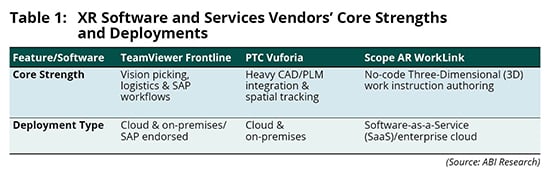
From preliminary research, prime verticals for these enterprise XR software developers include: logistics, automotive, field support, aerospace, manufacturing, defense, and energy. Additional insights and perspective will be forthcoming. ABI Research is actively researching the XR software and services sector and the analysis will be reported in Augmented Reality Software and Services (MD-ARS-103), which will be published later in 4Q 2026.
ABI Research anticipates there will be significant innovation over the next 5 years as XR hardware matures, comes down in “per unit” costs, and volumes scale. XR software development will leverage that momentum and integrate greater customization, Application Programming Interfaces (APIs), and AI agents to improve functionality and enterprise productivity.
Written by Jake Saunders
Related Service

- Competitive & Market Intelligence
- Executive & C-Suite
- Marketing
- Product Strategy
- Startup Leader & Founder
- End Users & Implementers
Job Role
- Telco & Communications
- Hyperscalers
- Industrial & Manufacturing
- Semiconductor
- Supply Chain
- Industry & Trade Organizations
Industry
Services
Spotlights
5G, Cloud & Networks
- 5G Devices, Smartphones & Wearables
- 5G, 6G & Open RAN
- Data Centers
- Enterprise Connectivity
- Space Technologies & Innovation
- Telco AI
AI & Robotics
Automotive
Bluetooth, Wi-Fi & Short Range Wireless
Cyber & Digital Security
- Citizen Digital Identity
- Digital Payment Technologies
- eSIM & SIM Solutions
- Quantum Safe Technologies
- Trusted Device Solutions