
The Next PNT Battleground: Iridium’s Head Start as New Entrants Emerge
 By Rachel Kong |
27 Oct 2026 |
IN-8322
Log In to unlock this content.
You have x unlocks remaining.
This content falls outside of your subscription, but you may view up to five pieces of premium content outside of your subscription each month
You have x unlocks remaining.
By Rachel Kong |
27 Oct 2026 |
IN-8322
NEWSLEO-PNT Developments: New Launch and Emerging Players |
Last year, the International Air Transport Association (IATA) estimates approximately 430,000 Global Positioning System (GPS) jamming and spoofing incidents occurred over conflict zones in 2024. It also reported that GPS spoofing incidents increased 193% and jamming events 67% between 2023 and 2025. This trend highlights growing vulnerabilities to current Global Navigation Satellite Systems (GNSSs), as attacks become increasingly accessible and easier to deploy; vulnerabilities span hardware and software systems, and threats are increasingly driven by state-sponsored actors. A traditional GNSS relies on Medium Earth Orbit (MEO) and Geostationary Earth Orbit (GEO) satellites, while Low Earth Orbit (LEO)-Positioning, Navigation, and Timing (PNT) leverages LEO satellites, providing significantly stronger signal power. In contrast, the relatively weak signals of GNSS with its outdated security protocols make them more susceptible to jamming and spoofing attacks. For example, in the maritime sector, GNSS provides critical PNT data to a wide range of interconnected systems and applications (e.g., Automatic Identification System (AIS), Electronic Chart Display and Information System (ECDIS), radar, gyro, autopilot, Global Maritime Distress and Safety System (GMDSS), Satellite Communication (SatCom), clocks, and more). Consequently, disruptions to a GNSS can have a cascading effect across multiple onboard systems and operations, highlighting the growing importance of ensuring GNSS integrity and reliability.
There are two main segments of PNT technologies: non-satellite and satellite. Non-satellite PNT refers to terrestrial and alternative technologies that provide PNT information without relying solely on traditional GNSSs such as GPS, GLONASS, Galileo, BeiDou and regional augmentation systems. These technologies include Inertial Navigation Systems (INSs), quantum sensors, visual navigation, and eLoran, among others. In contrast, satellite-based PNT relies on signals transmitted by satellites orbiting the Earth, mainly LEO and MEO, to determine precise position and timing information.
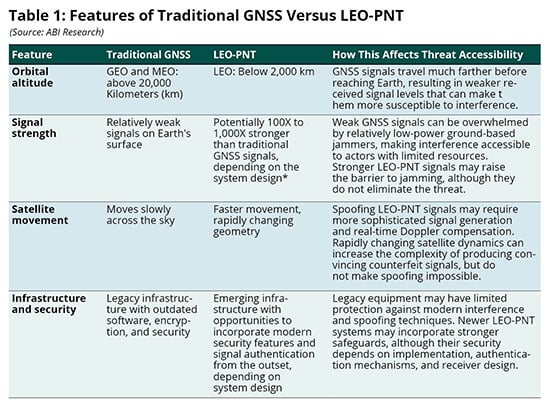
(*Note: See here for background on LEO-PNT signal strength.)
LEO-PNT solutions have begun to emerge in the market:
- Iridium Officially Launched Its PNT ASIC: In July 2026, Iridium announced the commercial availability of the Iridium PNT ASIC, the first PNT chip designed to protect GNSS-dependent devices from jamming, spoofing, and other threats. According to Iridium, it has received unprecedented demand from over 150 organizations worldwide, spanning maritime, aviation, telecommunications, Unmanned and Autonomous Systems (UXV), and other critical infrastructure sectors. When paired with Iridium-certified antennas, the service works in both outdoor and indoor environments (as a paid service).
- TrustPoint and Calian Deliver First C-Band GNSS Antenna: In October 2026, Calian successfully demonstrated its C-band GNSS antenna against TrustPoint’s live orbital satellite in orbit. The C-band signals operate in a higher, separate, and less congested frequency band, making it more resistant to jamming. Due to its higher frequency spectrum, the shorter wavelength uses highly narrow and directional beams, and jammers must be perfectly aligned to be a threat. This trial highlights a viable pathway to scaling the deployment of resilient PNT solutions using commercially manufacturable hardware. Prior to this, TrustPoint secured a US$4 million Tactical Funding Increase (TACFI) contract awarded by the U.S. Space Force to deploy and operated an end-to-end PNT system consisting of four satellites and four ground stations.
- Xona Space Systems Authorized to Broadcast Pulsar Navigation Signals: In August 2026, the Federal Communications Commission (FCC) approved Pulsar, a LEO constellation operated by Xona, to broadcast navigation signals in the L-band—the only private constellation to do so alongside other national and regional GNSS constellations.
IMPACTSo What? Implications for Suppliers, End Users, and the Competitive Landscape |
How will these developments impact end users and suppliers, and reshape the competitive landscape in the PNT and alternative PNT markets? First, the emergence and adoption of alternative PNT systems—regardless of being satellite or non-satellite PNT—will create more resilient systems protected against the growing jamming and spoofing threats. In conflict zones such as Ukraine, jamming and spoofing have disrupted satellite navigation, affecting the reliability of systems used for military and civilian operations. In addition, the European Space Agency (ESA) NAV4FutureMobility project integrated GNSS and LEO-PNT signals for Level 4 automated driving, demonstrating a 75% reduction in vertical positioning errors under degraded conditions. Alternative PNT systems will unlock growth across sectors such as autonomous mobility (including self-driving cars and Unmanned Aerial Vehicles (UAVs)), and precision timing for critical infrastructure like telco networks, data centers, and enhanced accuracy in different terrain types.
Second, these developments could have significant implications for hardware vendors delivering PNT solutions. Next-gen PNT will see mass-market commercial demand that requires producing new hardware. This presents an opportunity for chipset manufacturers to expand existing multi-GNSS, multi-frequency, and multi-orbit chipsets to incorporate multi-source PNT capabilities into their product portfolios. According to the Navigation Innovation and Support Programme Advisory Committee (NAVAC) established by ESA, the installed base of GNSS devices exceeded 6.5 billion units by 2021 and is expected to grow to 10.6 billion by 2031. Integrating it as a standard feature for consumer tech can trigger a huge replacement cycle across the antennas and receivers’ markets, creating new growth opportunities for hardware suppliers.
Third, this will intensify competition across both satellite-based and non-satellite-based PNT markets, attracting more entrants and encourage existing GNSS providers to expand their portfolios. In October 2026, the U.S. Space Force announced plans for the widespread global deployment of 56 satellite-jamming systems designed to disrupt adversaries’ communications. Such moves by national organizations can exacerbate the security dilemma, with one country’s efforts to strengthen its military capabilities perceived as a threat to other nations, prompting the rest to develop similar capabilities in response. As more nations invest in satellite-jamming technologies, the risk of GNSS disruption will increase, especially when the lines between military, commercial, and civilian satellite systems overlap. This growing vulnerability will drive demand and supply for more resilient and diversified PNT solutions.
RECOMMENDATIONSWhat Comes Next? Positioning for First-Mover Advantage in PNT Ecosystem |
- Strengthen Market Positioning Through Strategic Partnerships: As GNSS threats are an increasing concern, stakeholders must consider how to position themselves within an evolving PNT ecosystem. Successful commercialization will heavily depend on building a reliable and interconnected ecosystem. Chipset manufacturers, receiver and antenna vendors, PNT solution providers, satellite operators, telcos, and government agencies should establish Public-Private Partnerships (PPPs) to facilitate technology integration, interoperability, and market adoption. There is a current lack of common standards and certification frameworks across emerging PNT technologies, and potentially insufficient regulatory incentives for adopting GNSS-independent systems. Without clear requirements for resilience, organizations and end users have little incentive to invest in GNSS-independent backup systems for existing product line-ups or to justify the additional cost of deploying alternative PNT capabilities. Collaboration between chipset vendors and PNT providers would ensure hardware compatibility, while governments can establish resilience guidelines for critical infrastructure sectors. These can reduce fragmentation across the ecosystem, improve end-user confidence and adoption, and create a clearer pathway towards commercial adoption.
- Invest Early and Start Commercialization Preparation: For emerging LEO-PNT solutions, Iridium is a key example of how satellite-based services can be delivered commercially at scale. Today, it is the only player to have commercialized the technology, although several other companies are actively developing their own LEO-PNT solutions. Companies that want to capitalize on this opportunity should invest early, and act now before the market fully matures. This includes investing in Research and Development (R&D), developing compatible hardware, and identifying potential customers and use cases within the government and enterprise sectors.
Written by Rachel Kong
Related Service

- Competitive & Market Intelligence
- Executive & C-Suite
- Marketing
- Product Strategy
- Startup Leader & Founder
Job Role
- Telco & Communications
- Hyperscalers
- Industrial & Manufacturing
- Semiconductor
- Supply Chain
- Industry & Trade Organizations
Industry
Services
Spotlights
5G, Cloud & Networks
- 5G Devices, Smartphones & Wearables
- 5G, 6G & Open RAN
- Data Centers
- Enterprise Connectivity
- Space Technologies & Innovation
- Telco AI
AI & Robotics
Automotive
Bluetooth, Wi-Fi & Short Range Wireless
Cyber & Digital Security
- Citizen Digital Identity
- Digital Payment Technologies
- eSIM & SIM Solutions
- Quantum Safe Technologies
- Trusted Device Solutions