
Microsoft to Scale Maia Silicon Into Its Primary Inference Platform
 By Larbi Belkhit |
16 Oct 2026 |
IN-8319
By Larbi Belkhit |
16 Oct 2026 |
IN-8319
Log In to unlock this content.
You have x unlocks remaining.
This content falls outside of your subscription, but you may view up to five pieces of premium content outside of your subscription each month
You have x unlocks remaining.
By Larbi Belkhit |
16 Oct 2026 |
IN-8319
NEWSMicrosoft Commits to Maia as Its Primary Inference System |
In October 2026, Microsoft announced that it is set to scale deployment of its custom silicon Azure Maia program from next year to make the compute platform its primary inference system across Microsoft products and services. Its Maia 200 chips already serve production workloads, including Microsoft Copilot, and its MAI model team, with GitHub Copilot and Microsoft Foundry support coming by the end of this year. Across these workloads, this compute runs MAI and OpenAI models, as well as leading open-weight model families.
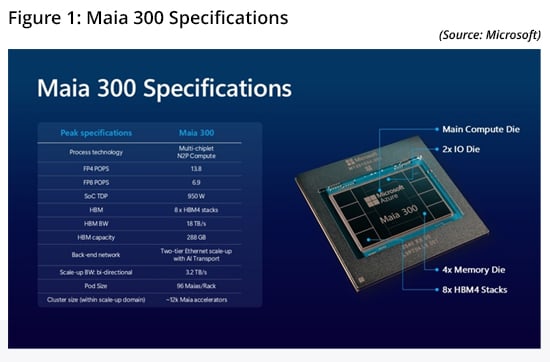
Its next-generation Maia 300 chip is planned for production deployments in 2027. This chip was designed for long-context, multi-step agentic workloads. Maia 300 features 8 HBM4 stacks and specialized kernel support that leverages on-die Static Random-Access Memory (SRAM) to reduce the pressure on High Bandwidth Memory (HBM). The new multi-chiplet architecture features separate compute, memory-controller & Input/Output (I/O) functions, built on Taiwan Semiconductor Manufacturing Company Limited’s (TSMC’s) N2P process node. Microsoft expects a 7X improvement for Maia 300 over Maia 200 and roughly 40% more tokens per Megawatt (MW) than leading Graphics Processing Unit (GPU) systems in the industry.
IMPACTCustom Silicon Strategies Showcase the Open Inference Landscape |
While Microsoft has not disclosed whether the ramp-up of Maia compute to “gigawatt-scale” will come from replacing older accelerator nodes or from new capacity coming online, ABI Research expects a combination of the two, skewing toward replacement of older GPU hardware such as NVIDIA’s Ampere and Hopper generations, given that the lower power consumption of the custom silicon makes it easier to serve agentic workloads within already built and established data centers. A major focus of the announcement is improving the ROI of compute running Microsoft’s own Artificial Intelligence (AI) applications and services. As the innovation in this space accelerates, replacing legacy hardware to improve token efficiency will help maximize returns on the data center build-out.
The announcement also reflects a wider shift in hyperscaler strategy through late 2025 and 2026. Any infrastructure serving inference directly to customers is under growing pressure to demonstrate stronger ROI, and custom silicon is the industry's response, alongside an agentic workload shift that places greater pressure on data movement. Amazon Web Services (AWS) has its Inferential and Trainium stack, and Google’s Tensor Processing Unit (TPU) line is bifurcating between training and inference optimization (for further analysis, please read ABI Insight “Google's TPU Split Reveals the Next Phase of AI Hardware Competition”). All three hyperscalers are increasing the volume of in-house custom silicon running production workloads. The drivers vary, but efficiency relative to available data center power is a main force in the industry, alongside cost pressures.
Hyperscalers are not the only players making this shift. OpenAI is developing its Jalapeno chips in collaboration with Broadcom, and Anthropic is rumored to be exploring custom accelerators of its own. Neoclouds will deploy NVIDIA’s Groq LPX as Vera Rubin moves into production. Still, ABI Research anticipates greater custom silicon activity from neoclouds in 2027, particularly those pursuing a full-stack AI cloud strategy. The key difference will be in inference system design. Hyperscalers will be more open to running the entire workload (prefill and decode) on custom silicon. At the same time, neoclouds will focus primarily on disaggregated inference, with GPUs handling prefill because they’ve already made significant investments in GPU procurement for training and inference. For challenger silicon vendors, this leaves neoclouds as the most open route to scale, since all three hyperscalers now have in-house programs in production. At the same time, GPUs remain the foundation for the frontier-model contracts that anchor the build-out. This doesn’t mean hyperscalers won’t source compute from them, but favorable deals are more likely from neoclouds.
RECOMMENDATIONSSeamless for Customers, Transparency for Investors Needed |
Customers of Azure services should not feel a negative difference in experience and should not be able to distinguish which architecture is serving their workload. That puts the burden on Microsoft’s inference engine, which will keep evolving to maximize performance, reliability, and latency across Maia and GPU capacity. With GitHub Copilot and Foundry moving onto Maia this year, any visible degradation to service experience could undermine the ROI case driving the shift.
The other side of the same coin is visibility for investors, who need a clearer view of the compute investments being made as custom silicon is a more recent shift for cloud providers. Microsoft should convey the cost-to-serve and power-efficiency gains of Maia over GPUs for inference, for example when running OpenAI models, on a clearly defined basis. The 40% tokens-per-megawatt claim is currently measured against “leading GPU systems” without a stated generation, latency target, or context length, so defining that baseline is the most useful first step.
Microsoft should also clarify how the Maia ramp-up affects GPU purchase orders and which data center footprint it will occupy. ABI Research expects NVIDIA and AMD purchase orders to be unaffected in the short term, as the market remains in a capacity deficit. Maia is most likely to be installed in legacy data centers rather than new builds, in line with the replacement-led ramp-up expected above, but this is not confirmed. Stating this clearly would mitigate market concern across the GPU, memory, and foundry supply chain.
Written by Larbi Belkhit
Related Service

- Competitive & Market Intelligence
- Executive & C-Suite
- Marketing
- Product Strategy
- Startup Leader & Founder
Job Role
- Telco & Communications
- Hyperscalers
- Industrial & Manufacturing
- Semiconductor
- Supply Chain
- Industry & Trade Organizations
Industry
Services
Spotlights
5G, Cloud & Networks
- 5G Devices, Smartphones & Wearables
- 5G, 6G & Open RAN
- Data Centers
- Enterprise Connectivity
- Space Technologies & Innovation
- Telco AI
AI & Robotics
Automotive
Bluetooth, Wi-Fi & Short Range Wireless
Cyber & Digital Security
- Citizen Digital Identity
- Digital Payment Technologies
- eSIM & SIM Solutions
- Quantum Safe Technologies
- Trusted Device Solutions