
Starship Launches First Batch of V3 Satellites: The Next Wave of Satellite Broadband Disruption Begins
 By Andrew Cavalier |
07 Oct 2026 |
IN-8301
By Andrew Cavalier |
07 Oct 2026 |
IN-8301
Log In to unlock this content.
You have x unlocks remaining.
This content falls outside of your subscription, but you may view up to five pieces of premium content outside of your subscription each month
You have x unlocks remaining.
By Andrew Cavalier |
07 Oct 2026 |
IN-8301
NEWSFirst Starlink V3 Satellites Deployed from Starship Flight 14 |
On September 28, 2026, SpaceX’s Starship flight 14 reached orbit and deployed 26 next-generation Starlink V3 broadband satellites. While a Starship catch attempt was not performed for flight 14, the launcher returned to earth and successfully deployed the Starlink satellites per its mission parameters: a mission success. SpaceX rates each V3 at 1 Terabits per Second (Tbps) of downlink, roughly 10X a V2 Mini used today by the constellation. That’s about 26 Tbps of nameplate capacity from a single launch, close to 10 Falcon 9 Starlink launches’ worth.
The mission success comes at a critical time as the space industry comes to grips with the impending retirement of Falcon 9 and SpaceX’s latest announcement to construct a new US$100 billion spaceport in Louisiana (United States), dubbed Starbase, LA, with construction slated for the beginning of 2027. The deployed Starlink V3 satellites are slated to begin operations in a few weeks, and more will come with follow-up Starship missions, so the Starlink network is now poised to make significant waves across the telecommunications landscape.
IMPACTV3 Is a Gamechanger |
Starlink V3 is poised to disrupt space and terrestrial broadband access markets. The satellite market is already facing immense pressure from SpaceX and remaining holdouts for the incumbent competition are concentrating in enterprise and government verticals. Indeed, based on the latest release of ABI Research’s Satellite Communications: Broadband Access market data (MD-SATCB-105), Starlink has achieved 85% market share in the satellite broadband access market in 2025 and is poised to reach over 91% share by the end of 2026 (over 15.6 million subscribers). On the terrestrial front, SpaceX teased its intent to augment the Starlink network with terrestrial infrastructure (femtocells) and is scaling commercial partnerships to capture the enterprise market.
While still an unlikely competitor in more mature markets, due to higher costs and high fiber build-out, emerging markets with limited infrastructure may find Starlink a compelling alternative with upgraded link capacity and lower projected service costs.
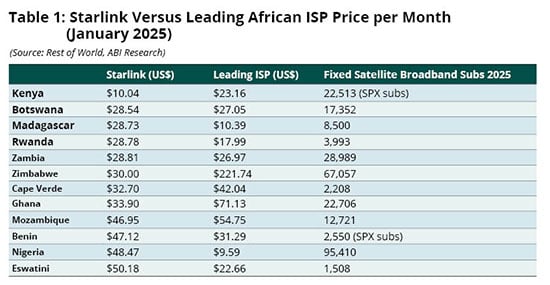
As can be seen across some African markets, satellite broadband is already an affordable alternative to leading Internet Service Provider (ISP) services and Starlink, in particular, has become a significant provider of Internet services in the region. Starlink V3’s increased capacity and bandwidth, and this pricing gap is expected to grow in underserved markets as the constellation scales.
While Starlink V3 does promise impressive upgrades over its predecessor, Starlink V3 is still largely dependent on Starship’s launch cadence. At this stage, Starship is not fully operational, but flight 14 has proven that the launcher can get the satellites into orbit. SpaceX states that Starship V3 will target ~60 V3 satellites per launch and up to 30 launches per day with all planned launch pads online, a very ambitious number. To put a more realistic perspective to this network’s outlook, ABI Research has modeled the Starlink Constellation at the end of 2027 below.
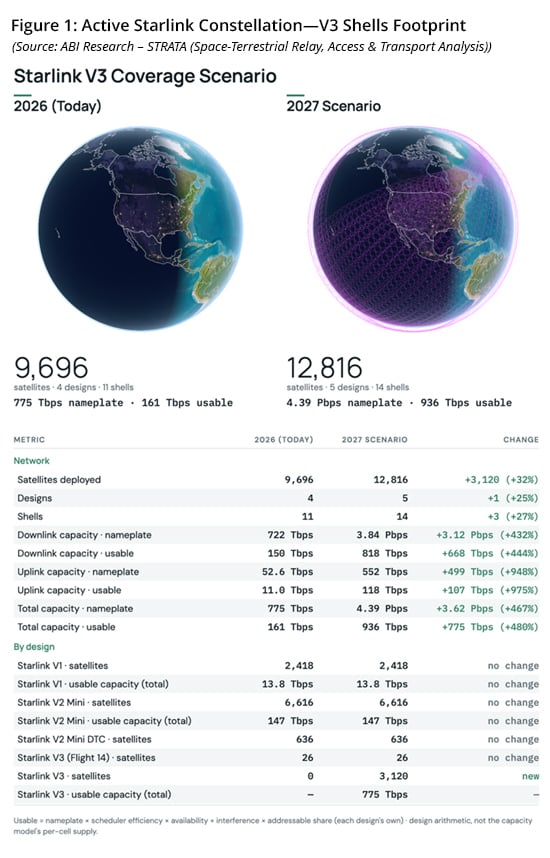
Rather optimistically, the scenario modeled assumes SpaceX achieves the equivalent of 1 Starship launch per week with 60 V3 satellites each launch in 2027 for the Starlink constellation alone. This would bring the entire Starlink constellation to about 3.6 Petabytes per Second (Pbps) of total nameplate capacity (nameplate capacity is the theoretical maximum throughput that can be delivered at full spectral efficiency with zero losses) and an estimated 936 Tbps of usable capacity (usable capacity is what capacity is available to customers after applying real-world derates), roughly 8% of nameplate. At this rate, assuming no increase in launch volume or satellite design enhancements, Starlink would reach 8.8 Pbps nameplate and 1.88 Pbps of usable capacity by 2030. For this scenario, addressable share is computed as a fraction of each satellite's coverage footprint that lies over land, averaged along the orbit. It uses a 25° elevation mask and Natural Earth land with Antarctica excluded. It also ignores ships and aircraft, and beams steered toward demand. It also counts empty and unlicensed land. SpaceX hasn’t published orbital plane structure, so deployment is inferred from Gen 2 filings.
RECOMMENDATIONSStarlink V3 Opportunity and Threats |
The Starlink constellation presents unique challenges and opportunities for the telecommunications industry. On one hand, terrestrial CSPs will find a cutting-edge space network to implement as a hybrid solution offering within their portfolios (see ABI Research’s Terrestrial Fiber and Satellite Broadband: Rivals in Coverage, Partners in the Enterprise report (AN-6612). On the other hand, Starlink is continuing to build solutions catered for the enterprise and government markets while lowering affordability for the consumer market. With the 10X capacity per launch from V3, SpaceX’s cost per Gigabits per Second (Gbps) is collapsing. For telcos, partnering with Starlink at the edge and enterprise will be a key unlock for building new hybrid services for customers, but sign a second partner so leverage and pricing power is maintained. For chipset vendors, SpaceX is shrinking merchant market. SpaceX uses its own beamformers and modem chips, so targeting third-party terminals that can match Starlink pricing is priority.

Written by Andrew Cavalier
Related Service

- Competitive & Market Intelligence
- Executive & C-Suite
- Marketing
- Product Strategy
- Startup Leader & Founder
- Users & Implementers
Job Role
- Telco & Communications
- Hyperscalers
- Industrial & Manufacturing
- Semiconductor
- Supply Chain
- Industry & Trade Organizations
Industry
Services
Spotlights
5G, Cloud & Networks
- 5G Devices, Smartphones & Wearables
- 5G, 6G & Open RAN
- Data Centers
- Enterprise Connectivity
- Space Technologies & Innovation
- Telco AI
AI & Robotics
Automotive
Bluetooth, Wi-Fi & Short Range Wireless
Cyber & Digital Security
- Citizen Digital Identity
- Digital Payment Technologies
- eSIM & SIM Solutions
- Quantum Safe Technologies
- Trusted Device Solutions