NEWS
The Launch of the Galaxy Z Fold8 & Fold8 Ultra
|
The presence of smartphone “foldables” has been gaining visibility in the market. Putting aside the clamshell feature phones, the first foldable smartphone with a fully contiguous screen came out in 2018, the FlexPai by Royole. Since then, the number of foldable models in the market has grown at a Compound Annual Growth Rate (CAGR) of 66% per year (from 2018 to 2024). Samsung has been a “major player in the foldables space since 2019 and is now up to its 8th series of foldable phones. In late July 2026, Samsung unveiled the Galaxy Z Fold8, as part of its expanded foldables lineup, positioning it as a new content-focused option alongside the productivity-oriented Galaxy Z Fold8 Ultra and the Galaxy Z Flip8.
The Galaxy Z Fold8’s most distinctive feature is its new screen format. The phone comes with a 10:16 cover display for easier scrolling and a 4:3 main display that is intended for video, reading, and immersive content consumption. Hardware specifications-wise, the smartphone comes with a dual 50-Megapixel (MP) rear camera system and the Snapdragon 8 Elite Gen 5 for Galaxy as its main Accelerated Processing Unit (APU).
Certainly, the new more compact foldable form factor of the Galaxy Z Fold8 is drumming up media interest, but the Fold8 range is also hiding a remarkable hardware innovation that could be a significant game changer for foldable smartphones—Flex Titanium, a structural change to the way foldable screens are supported. More crucially, it serves to pretty much remove the “crease” that was often extant on foldable smartphones.
IMPACT
A New Type of Substrate
|
Most existing smartphone foldables are made from a layered stack and not a single material:
- Flexible Organic Light-Emitting Diode (OLED) display panel at the core
- Ultra-Thin Glass (UTG)
- A plastic/polymer protective top layer above the UTG
While the UTG provides a certain amount of rigidity, the two flexing “wings” of the foldable smartphone result in a subtle but often noticeable crease down the middle. For its latest generation of foldables, Samsung has redesigned the internal display structure around two titanium components: 1) a Titanium Alloy Film beneath the OLED panel that serves as a support layer with 20X greater stiffness than conventional polymer films; and 2) a Titanium Plate beneath the display module with a micro-patterned folding zone that can flex (see Figure 1). Samsung has also paired this structure with a high-resolution display architecture and next-generation OLED organic materials that can deliver image quality while also lowering power consumption.
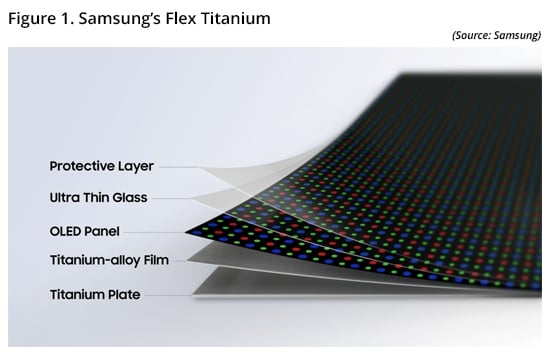
These are still very early days, but the initial launch was well received, and the demos seem to indicate a significantly lower crease profile for the device. Furthermore, improved strengthening by utilizing the titanium plate could reduce the number of fractures and chipped screens that have been reported. No explicit reporting has been documented for the repair rate of plastic/polymer protective over UTG, but there is anecdotal reporting. The titanium plate should make the assembly significantly more robust.
RECOMMENDATIONS
Market Outlook
|
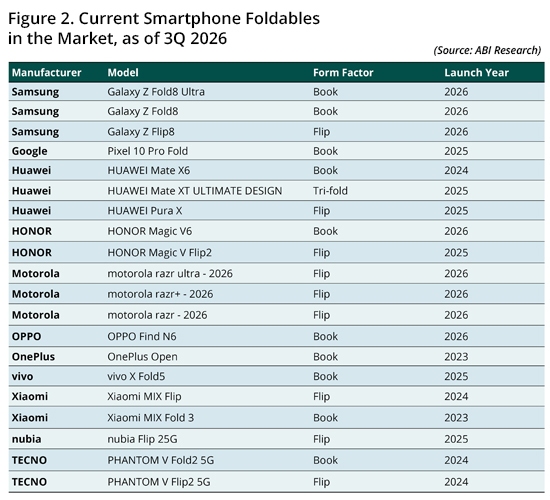
The new form factor of the Samsung Galaxy Z Fold8 combined with the titanium plate could potentially expand the potential market potential for foldables. There are at least 11 handset vendors producing foldables (see Figure 2). That list is likely to expand further. Indeed, Apple is anticipated to introduce a foldable into the market in late 2026 or early 2027. Wholesale prices for foldables are very much at the exclusive end, ranging between US$1,000 and US$2,000 for existing foldables. The Fold8 is likely to start selling at US$1,900 for the basic configuration and potentially go up to US$2,550 for the Galaxy Z Fold8 Ultra 16 Gigabyte (GB) + 1 Terabyte (TB) configuration.
In 2025, 1.24 billion smartphones were shipped. The outlook for 2026 is a contraction of -5.1% due to geopolitical turmoil and Random-Access Memory (RAM) prices. The mid-term forecast also projects continued decline. However, the top end of the market may be more resilient, and be prepared to expand spending on the form factor. ABI Research is currently researching the market size and dynamics of foldables. Foldable smartphone prices are likely to continue constraining adoption, but the improved screen profile and reliability could still work in Samsung’s favor.
In summary, ABI Research considers the introduction of Samsung Fold8 to be a transformative development in the smart devices sector. There are other novel applications/form factors, such as robotics (e.g., the HONOR Robot Phone), that are testing the curiosity of the smartphone market, but foldables have the potential to redefine the smart devices marketplace.