NEWS
Scale-Across Accelerates OLS Growth
|
Open Line Systems (OLS) have emerged recently to break the vendor monopolies in the optical transport section. Driven by large hyperscalers that designed their own systems, OLS is now aiming to commoditize scale-across systems for any company that aims to deploy multiple data centers in the same geographical region. Artificial Intelligence (AI) data center cluster scaling has reached saturation due to energy constraints and other factors, causing operators to distribute their AI frontier model training across a campus, state, or even region. This has turned scale-across from theoretical concept to necessary in the past 18 months for Data Center Interconnect (DCI). At the same time, neoclouds are scaling their operations significantly, requiring scale-across interconnections between their data centers.
This market evolution is like the telco domain in which Open Radio Access Network (RAN) promised to open and disaggregate cellular network infrastructure, but remains on the fringe. After 8 years of development in the O-RAN Alliance, national and private grants, investments, and Mergers & Acquisitions (M&A), Open RAN has still not managed to break through to the mainstream market. On paper, Open RAN aimed to achieve what OLS is now succeeding in: freedom from vendor lock-in, decoupling of software from hardware, and supply chain diversification. The reason it failed is market-driven and structural, outside the control of Open RAN protagonists. It is the companies deploying these systems that marked their commercial trajectories.
IMPACT
Hyperscalers Made the OLS Market; Telcos Have Predestined Open RAN
|
The differences between the cloud and telco markets are largely the reason Open RAN failed, whereas OLS is commercially successful with vendors like Adtran, EdgeCore, Ekinops, Packetlight, and Smartoptics. This table summarizes the differences between the two markets and supply chain.
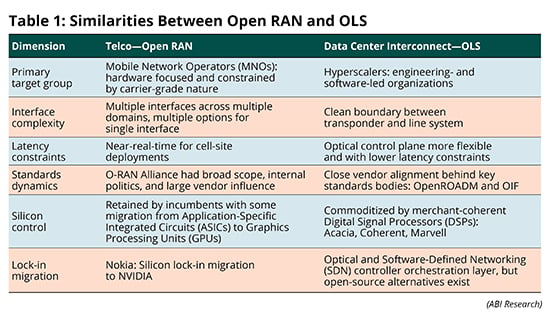
This table illustrates the structural differences between the two markets, the most important of which are the following:
- For RAN, silicon and custom infrastructure is the most profitable business segment for large telco vendors for commercial, strategic, and technical reasons. The performance and price/unit for custom ASICs cannot be matched, but GPU capabilities in the RAN are evolving rapidly and pushed forward by NVIDIA’s endless investment appetite. On the other hand, in the DCI space, silicon is completely commoditized in the OLS space by merchant silicon, albeit these vendors are counted on the fingers of one hand.
- The demand side couldn’t be more diverse in the two markets. On the DCI side, hyperscalers and neoclouds are software-led organizations with formidable engineering teams, some of which have created dominant open-source projects, including Meta’s Open Compute Project and Microsoft’s SONiC. On the other hand, in the cellular space, telcos rely largely on end-to-end systems provided by large vendors, and their engineering teams have winded down due to financial pressure.
Due to these factors, OLS has succeeded where Open RAN failed and the next wave of evolution in OLS is coming.
RECOMMENDATIONS
Optical Network Orchestration Coming Next in OLS
|
So far, OLS has succeeded in breaking the vendor lock-in for hardware, and small vendors are growing their presence with white boxes and OLS products. As presented in the table above, the interfaces and standards for OLS are clear and well specified, meaning that this market will grow, despite the also growing dominance of transport vendors, including Ciena and Nokia/Infinera. The next wave of innovation and competitive differentiation will now be software and, specifically, optical SDN controllers that will need to move massive amounts of data across hundreds of kilometers. Ciena, Cisco, and Nokia have their own solutions in this domain—most of which are proprietary, but there are also open-source projects in the market, namely the Open Network Operating System (ONOS) and OpenDayLight (ODL). Ironically, both projects have roots in the telco domain, designed to efficiently transfer telco network traffic, but were mismatched due to the carrier-grade and vendor-heavy nature of telcos. On the other hand, they are perfectly matched with cloud and AI networking applications.
The opportunity for OLS vendors is to reduce the operational complexity of these systems and make them available for anyone who doesn’t have the engineering might of hyperscalers. This is where the next battle in scale-across will be fought: in optical SDN, optical orchestration software that bridges the AI and transport domains. This is where companies like Adtran, Ekinops, Smartoptics, and incumbents like Ciena and Nokia will compete aggressively to control.