NEWS
Motive Launches AI Dashcam Plus: Unified Device with Advanced AI and Stereo Vision
|
Motive has launched AI Dashcam Plus, its new flagship camera that combines vehicle gateway capabilities into a single Artificial Intelligence (AI) dashcam device. With the unified device, Motive brings improved AI functionalities combined with hands-free communication and reliability together using edge AI designed to detect risks faster and prevent more collisions. AI Dashcam Plus delivers 3X more AI processing power than other leading dash cams and can run more than 30 high-precision AI models simultaneously, enabling broader detection with fewer false alerts. These are the key features:
- Stronger Processing Power: AI Dashcam Plus is capable of running more than 30 high-precision AI models simultaneously, supporting an expanded range of detection capabilities. These updates are designed to enable AI Dashcam Plus to detect more unsafe behaviors in real time with higher accuracy and less latency.
- Stereo Vision for In-Depth Vision: The new device uses two synchronized road-facing lenses to create human-like depth perception, enabling the AI to judge distance and closing speed with far greater accuracy.
- Automated License Plate Recognition (ALPR): AI Dashcam Plus has a 1440p zoom lens with a narrow field of view, enabling ALPR to capture clear license plates, even in motion, from long distances or in bad weather.
- Advanced Sensor Fusion: AI Dashcam Plus integrates video, audio, telematics, Global Positioning System (GPS), and dual motion sensor data to detect more complex events.
To further enhance driver safety, the AI Dashcam Plus offers hands-free communication to help drivers instantly connect with managers using voice-activated control. With this feature, managers can check in with drivers about issues such as fatigue or severe weather, while drivers can safely report a maintenance issue, request directions, and respond to managers. In addition, drivers on duty can use a simple “Hey Motive” voice command for use cases like highlighting critical video footage, checking remaining drive time, confirming the next stop, and finding the nearest fuel stop, without taking their hands off the wheel or eyes off the road. Automated alerts can be created that prompt drivers to immediately address time-sensitive issues such as critical fault codes and excessive idling. And its Android-based architecture and improved connectivity ensure reliable uploads of critical footage, and enable rapid feature updates for voice, audio, and AI services.
IMPACT
Growing Safety Challenges and the Need for Advanced Solutions
|
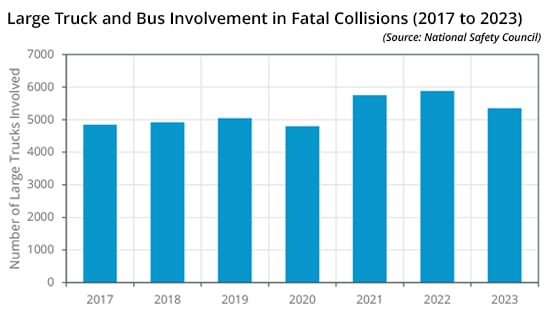
Commercial driver safety remains a critical concern. In the United States, the Federal Motor Carrier Safety Administration (FMCSA) reported that fatalities involving large commercial vehicle collisions exceeded 5,400 in 2023, as seen in the chart below. There were fewer fatal collisions in 2020 during the COVID-19 pandemic due to less traffic; however, collision numbers quickly increased to more than pre-pandemic levels at a record high of 5,873 in 2022. Though slightly lower in 2023, a continued trend in fatal collisions persists, highlighting how risky driving behavior remains a serious issue. In Europe, despite long-term progress, collisions involving heavy goods vehicles still account for a large number of fatalities across the European Union (EU) each year, keeping commercial vehicle safety central to “Vision Zero” targets to eliminate road fatalities by 2050.
A major contributor to these risks is unsafe behavior and fatigue, and technologies have addressed these pain points with targeted multimodal driver distraction and fatigue detection systems that fuse vision, vehicle dynamics, and physiological signals to issue timely warnings. In addition, organizations are under pressure from regulators, insurers, and shippers to document proactive safety management, which is helping drive the adoption of AI-enabled dashcams and driver monitoring systems. Original Equipment Manufacturers (OEMs) and telematics providers are increasingly integrating these cameras with electronic logging devices and back-office platforms so safety teams can automate coaching workflows, measure behavior change, and defend against litigation with objective video and sensor evidence. Collision rates are still high, so video-based AI safety technologies that combine precise AI models, stereo vision, hands-free communication, and multi-sensor data are becoming essential to commercial driver safety, not optional add-ons.
Similar developments can be seen in Europe. A defining trend is the tightening of vehicle safety regulation through the EU’s General Safety Regulation (GSR) that every truck and bus registered in Europe by vehicle manufacturers from July 2024 onward must include specific automatic driver assistance safety features. These mandates are being phased in with additional safety functions planned for 2026 and 2029, pushing OEMs to embed more intelligent sensing, automation, and Human-Machine Interfaces (HMIs) into their heavy vehicle platforms.?
As regulatory mandates tighten and organizations' fleets face mounting pressure to operationalize proactive safety management, the role of aftermarket video safety solutions becomes critical. Unlike basic OEM-installed cameras, advanced aftermarket systems like Motive’s AI Dashcam Plus offer rapid innovation cycles, deeper AI capabilities, and integration flexibility across diverse fleet types. These solutions enable organizations to upgrade safety performance without waiting for full vehicle refresh cycles, ensuring compliance with evolving standards while reducing operational risk.
RECOMMENDATIONS
Best Practices for Ecosystem Partners
|
For organizations seeking to protect their employees, reduce liability, and maintain competitive advantage, investing in high-quality aftermarket video technology is no longer optional—it’s a strategic imperative. Combining stereo vision, multi-sensor fusion, hands-free communication, and telematics in a single device makes for a very powerful and actionable tool. With AI Dashcam Plus, Motive delivers a scalable and future-proof approach to bolster video safety. Motive’s recent innovations have resulted in an “overall leader” and “top innovator” placement in ABI Research’s Commercial Video Telematics Vendors competitive assessment (published February 2026), which assesses and ranks leading players in the industry. As the adoption of AI-enabled video safety solutions accelerates, ecosystem players need to be mindful of several critical factors. Beyond hardware specs, success depends on interoperability, ease of deployment, and long-term scalability to meet evolving regulatory and operational demands. Beyond solution providers, below are some of the key recommendations for key ecosystem players, including integrations, installation partners, and end users:
- Integrations and Installation Partners: When recommending solutions to enterprise customers, prioritizing solutions with unified hardware design to reduce installation complexity and minimize failure points is key. There is also a critical need to ensure compatibility with existing telematics and fleet management platforms for seamless integration, and to validate systems that support over-the-air updates for AI models and firmware for future-proof deployments.
- Commercial Fleet Operators: No matter what industry, organizations with employees operating commercial vehicles and other heavy equipment face increasing risks. They’re continuously striving to improve safety and increase operational efficiency, making the role of fleet and safety managers even more vital. To optimize outcomes, these key players should work closely with digital transformation leads at their organizations to focus on successful pilot deployments before scaling across their fleets.
To justify these investments to upper management, organizations should treat pilots as both operational tests and change management exercises to build strong business cases for full rollouts. This is where doubling down on features like ALPR and new use cases that are unlocked due to advanced sensor fusion becomes important. Lastly, for tangible Return on Investment (ROI), organizations should proactively integrate video into their training and coaching programs. Along with safety tools like personalized coaching, fleet and safety managers need to address recurring safety trends, and reinforce long-term behavior change through video analytics and safety scores.