NEWS
FCC Votes to Introduce an Additional 6 GHz Wi-Fi Operating Class
|
On January 29, 2026 the Federal Communications Commission (FCC) in the United States voted to create a new 6 Gigahertz (GHz) Wi-Fi operating class, Geofenced Variable Power (GVP). GVP devices will be permitted to operate both indoors and outdoors at higher power levels than the existing Low Power Indoor (LPI) and Very Low Power (VLP) operating classes, which the FCC argues will be particularly valuable for data-intensive applications and for overcoming the potential impact of attenuation faced by body-worn applications. This will be made possible by limiting the operation of GVP devices to select frequencies within a geofenced zone, a measure that will prevent GVP devices from interfering with other incumbents in the band. The FCC is the first and only regulator to have introduced GVP, and the move follows a long list of pioneering 6 GHz policy decisions from the FCC, which collectively have helped to extend the U.S. lead in Wi-Fi technologies. In this ABI Insight, we will delve into the technical foundations and the market impact of GVP, and attempt to assess the significance of its introduction on the broader industry.
IMPACT
GVP to Improve Outdoor 6 GHz by Addressing Gap in Existing Operating Classes
|
The FCC’s vote to approve the GVP operating class is unprecedented, as no other national regulator has even proposed introducing the class, let alone voting on permitting it. Given that GVP is a fresh innovation within the Wi-Fi industry, it is worth contextualizing its significance by outlining what differentiates it from the existing operating classes and articulating why it is necessary. Table 1 lists all the 6 GHz Wi-Fi operating classes in the United States, which accounts for a total of four with the addition of GVP. These different operating classes, which place varying restrictions on power levels and operating locations, are designed to allow Wi-Fi transmissions in 6 GHz without causing interference with the many incumbents in the band, which range from emergency services to public utilities. The first class in the table, LPI, is limited to indoor operation only, with the assumption that the walls of the building will prevent interference. The other three classes are all aimed at enabling the potential of 6 GHz operation in outdoor environments, while also preventing interference with incumbents, which is more challenging than indoors because the absence of walls heightens the likelihood of interference.
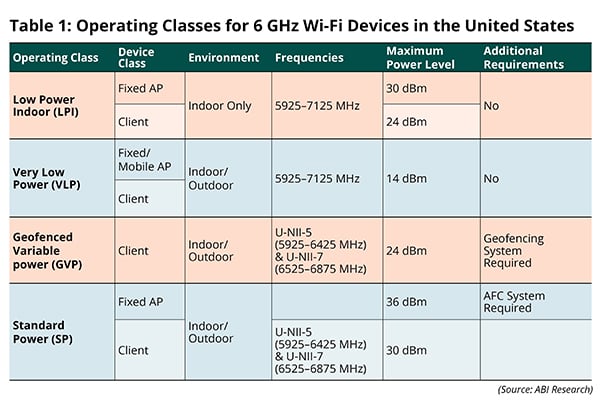
The first of these outdoor 6 GHz operating classes, VLP, was the first to be authorized, arriving alongside the releasing of the 6 GHz for unlicensed use by the FCC back in 2020. While the low 14 Decibel-Milliwatt (dBm) power levels of VLP do act to avoid interference with other 6 GHz incumbents, these restrictions also negatively impact range and performance, degrading user experiences. The first attempt to overcome this limitation, and to unleash the full capabilities of 6 GHz, came with Standard Power (SP) 6 GHz. With SP 6 GHz, higher power 36 dBm 6 GHz transmissions are permitted via the use of Automated Frequency Coordination (AFC) systems, which are essentially database lookup schemes that first certify the absence of incumbents in the band at any given locality before permitting transmissions at SP levels. Transmissions are allowed only in two authorized U-NII bands, U-NII-5 (5925–6425 MHz) and U-NII-7 (6525–6875 MHz), to avoid any possibility of interference with sensitive incumbents in the other sections of the 6 GHz band. While SP 6 GHz has delivered vast improvements to 6 GHz Wi-Fi range and performance, the necessity of a complex and often costly AFC system means that adoption of the class is primarily concentrated within the enterprise market. Through the addition of GVP, the FCC aims to fill the gap between VLP and SP 6 GHz. With a 24 dBm limit, GVP will not be handicapped by VLP’s restrictive power levels, while at the same time GVP will not be burdened by the AFC requirements of SP. The intention appears to be that GVP will be targeted at improving 6 GHz operation for the general consumer, with the FCC highlighting many consumer applications in its press release, including Augmented Reality (AR)/Virtual Reality (VR), smart devices, and short-range hotspots.
RECOMMENDATIONS
How Will GVP Fare Outside of the United States?
|
Authorizing GVP is just another demonstration of the FCC’s commitment 6 GHz spectrum policy global leadership. This leadership began when the regulator became the first to release the entire band (5925–7125 MHz) for Wi-Fi in 2020, and was reinforced when the United States became the first to enjoy SP 6 GHz operation and when the FCC voted to extend VLP device operation from 850 MHz of the 6 GHz spectrum to the entire 1200 MHz of the band in December 2024. Yet although the FCC was a pioneer on these decisions, it was not a trendsetter, as many other countries chose not to emulate the U.S. approach. For example, the European Union has only assigned the lower portion of the 6 GHz band for unlicensed (spanning 5925–6425 MHz), and Mainland China has not allocated any of 6 GHz for unlicensed use, instead reserving the entire band for cellular usage. These examples highlight the fractured landscape of 6 GHz access globally, an entrenched divergence that shows no sign of changing soon. The situation is even more dire for SP 6 GHz, because aside from Canada, no other country has followed the U.S. lead and authorized the technology.
Yet the failure of countries outside of North America to implement SP 6 GHz does not mean that GVP will meet the same fate. GVP has been designed to address different use cases than SP, and its operational requirements are also significantly less, meaning that there are different incentives for a regulator to authorize its operation, and device certification should be simpler. Furthermore, there are different stakeholders involved. Whereas SP 6 GHz deployments were predominantly concentrated in the enterprise sector, GVP is being envisioned as a technology that the general consumer will use to power their data-intensive devices. Reflecting the importance of GVP for consumer devices, Apple and Meta were two of the leading proponents for the new operating class. Should GVP prove to be a success in the U.S. market, then it is likely that other nations that have emulated the United States and also released the entire 6 GHz band for unlicensed use will be the first to adopt the GVP class. Such nations include Canada, South Korea, and Saudi Arabia.
As with SP 6 GHz, GVP 6 GHz operation would be impaired in countries that do not have access to the entire 6 GHz band, because the spectrum available for operation would be limited. While some countries that only have access to the lower 6 GHz band are considering allowing spectrum sharing between Wi-Fi and cellular in the upper 6 GHz band, all currently proposed methods (such as the approach under consideration by U.K. telecommunications regulator Ofcom) would have Wi-Fi power limits capped to LPI or VLP levels. Therefore, if countries with limited unlicensed access to the 6 GHz band wish to realize the full potential of GVP, then it is suggested that they either expand unlicensed access to the full 6 GHz band, or identify innovative ways to achieve spectrum sharing between Wi-Fi at GVP levels and cellular in the upper 6 GHz band.