As 2025 closes out, it is now only 4 to 5 years before “6G” is anticipated to be commercially adopted on a widespread basis. But it will likely be some pioneer mobile operators that will deploy it by 2028. Northeast Asia or possibly the United States may be the first to market. Various study groups are working on 6G study programs for Radio Access Network (RAN), transport network, cloud/data center, and core network. This ABI Insight delves into the vision, concerns, and suggestions regarding the core network domain from operator discussions and briefings following an “AI Core for ACN Summit” hosted in Shanghai in mid-2025.
IMPACT
Key Objectives for the 6G Core
|
The 3rd Generation Partnership Project (3GPP) and its stakeholders are very much walking a tightrope. 5G has been more variable in its Return on Investment (ROI) for the operator community than previous cellular generations. Part of the challenge has been 5G being rolled out at different rates, which has impacted market adoption and economies of scale, but also incurred additional complexity.
Therefore, 3GPP has put the focus on fixing those 5G complexities while making available functional, "native" capabilities that were previously treated as “add-ons” in 5G. While 5G was about "connecting everything," 3GPP’s vision for the 6G Core is about native intelligence, maximizing simplification, and ensuring there is “business-driven,” a.k.a. “intent-driven” design in 6G. The key objectives of the 6G core include:
- Sustainability: The 3GPP community is striving to reach "net zero." A 6G Core should, therefore, include processes to "switch off" unused network elements dynamically and optimize the energy-per-bit consumed.
- Efficiency: A major criticism of 5G was its architectural complexity (i.e., the various "Non-Standalone (NSA)" versus "Standalone (SA)" options). For 6G, the goal is a lean, streamlined architecture that reduces operational costs.
- Integrated Sensing and Communication (ISAC): The 6G Core will be able to leverage its RAN assets as a radar-like sensor. The network would be able to sense and map the physical environment around it in real time.
- Network for Artificial Intelligence (AI): The telco community wants to ensure that 6G deploys a native AI architecture, rather than AI as an external "plug-in” for today’s 5G network. A 6G network could then use AI as an integrated “control loop” for managing traffic, etc.
- Connectivity Everywhere: Non-Terrestrial Network (NTN)/satellite services are being integrated into 5G, but 6G will unify satellite, aerial (drones), and terrestrial networks into a single, seamless core.
An example of how some telcos are viewing 6G Core development can be found in Figure 1, which highlights NTT DOCOMO’s (Japan) priorities and considerations in relation to these 3GPP 6G objectives. In the case of NTT, the operator intends to harness the development of photonics-electronic chipsets, as well as advanced customer experience augmentation that could even integrate all five senses that a human can experience.
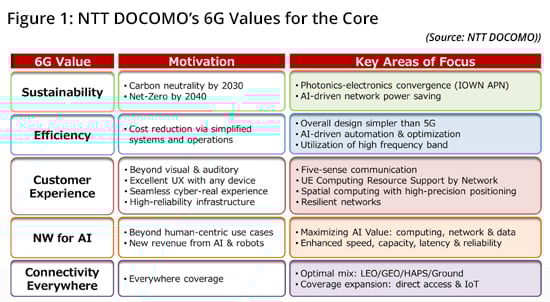
From a core network architecture point of view, 6G Core is expected to evolve from the Service-Based Architecture (SBA) of 5G toward a more "cognitive" or "capability-inclusive" architecture. This would allow greater compute-communication convergence, as well as integrated sensing services than the current very “communications-centric” architectures support. Furthermore, it would allow third parties (Over-the-Top (OTT) players, software developers, etc.) to plug into the telco’s 6G network via unified common Application Programming Interfaces (APIs).
A Platform for AI Integration and Acceleration
The above objectives are the foundations, but many 3GPP stakeholders have a bolder vision for AI integration. From discussions that ABI Research has had with Communications Service Providers (CSPs) headquartered in Asia and Europe, they believe an AI-core network should provide trusted access, interconnection, and task cooperation for multiple AI agents. Several telcos are prototyping and evaluating various AI-core network setups:
- In mid-2025, China Mobile Research Institute, announced an ACN experimental suite from China Mobile that connects with multiple types of AI agents such as robotics, drones, Augmented Reality (AR) glasses and digital AI agents. It supports both China Mobile Research Institute’s Net4Agent and Agent4Net. Net4Agent is able to do trusted access, dynamic sub-network, computing offloading, and coordination among multiple AI agents. Agent4Net takes on the Agentic AI for network function and AI agent protocol design, and enables network capability exposure.
- European telcos are also setting out their visions for 6G. KPN Fieldlabs has been developing a Holistic Service-Based Architecture (HSBA) + AI Service Management and Orchestration (SMO) concept. The 6G AI Core network instance has both an agent-based interface and service-based interface within its AI SMO. The SMO solution can handle various kinds of AI agents, including planning, assemble, connection, and execution agents that interwork with agentic functions.
- Orange (France) has been building up experience in AI. In 2024 alone, the operator rolled out 150 AI use cases that have generated €200 million in value. Orange has taken that expertise and in collaboration with Nokia Bell Labs and IBM hopes to have developed its CogNet (Cognitive Network). CogNet is designed to shift processes from "reactive" network management to "proactive cognitive" management. CogNet will evolve from a Level 3 to Level 4 autonomous platform that will provide AI-based tooling for Orange Network Operation Centers (NOCs) in Europe that covers all network domains.
RECOMMENDATIONS
Countdown Has Begun
|
The principal features of the 6G Core should start to coalesce by the end of 2026. There are very strong indications that the 6G Core will have a strong AI theme. Several 3GPP stakeholders are very enthusiastic about tightly integrating even Agentic AI into the core. However, there are several challenges:
- AI development in the wider ecosystem is growing at breakneck speed, whereas 3GPP has an iterative process that has a cadence of 1.5 to 2.5 years between releases. How does the telco community keep up, or best harness, the innovation at scale that the mainstream AI development community can deliver?
- Telcos face the prospect of scaling millions, even billions, of AI agents, so how should telco operators provide new functionalities or new network protocols to manage these processes? It is likely to require guide-rails with certain agents and processes having approved status, whereas other more insufficiently tested agents are prevented from operating.
- In a world with 700-odd telcos, challenges exist regarding the interoperability and upgrade of the installed base of terminals and network equipment, which slows down service innovation. How should the telco community improve the coordination and upgrades of not just the network elements, but also terminal equipment?
- One of the fundamental tenets of the 6G Core vision is “maximizing simplification,” but given the pressures to introduce the latest AI features, it may prove challenging to reduce complexity and keep costs down. How to streamline the process?