Recent AI Agent Announcements
|
NEWS
|
Over the past few months, the supply chain management technology landscape has rapidly entered the Artificial Intelligence (AI) agent era. Solution providers like Oracle, IBM, Kinaxis, and C.H. Robinson have each unveiled major initiatives that demonstrate how AI agents can potentially reshape supply chain execution, planning, and coordination:
- Oracle: Oracle announced AI agents for its Fusion Supply Chain and Manufacturing suite, integrating natural language understanding, decision automation, and predictive analytics to boost operational efficiency across procurement, logistics, and maintenance.
- IBM: IBM followed suit with Oracle by expanding its AI agent marketplace through collaboration with Oracle Fusion Applications, making specialized agents available for finance, Human Resources (HR), and supply chain management. This underscores the growing modularity of enterprise AI ecosystems.
- C.H. Robinson: The supply chain giant embedded a suite of AI agents directly into its Navisphere platform, enabling dynamic freight matching, real-time exception management, and automated customer communications.
- Kinaxis: Kinaxis introduced its "Agentic Era" strategy by combining autonomous AI agents with its RapidResponse platform to support self-optimizing supply chain planning and execution.
These announcements signal a potential shift from predictive analytics toward autonomous orchestration, where digital agents make recommendations and take action. Across these innovations and announcements, the focus for users will be to drive agility and reduce latency in decision-making by unlocking real-time collaboration between systems and human planners.
Market Appetite for AI Agent-Focused Use Cases
|
IMPACT
|
In light of innovations and announcements, it is also imperative for solution providers to take a closer look at the market's outlook on AI agents. This year, ABI Research surveyed 490 supply chain decision makers (including C-level executives, digital transformation leads, etc.) regarding their challenges, prompts to choose solution providers, and appetite for different technologies. Among the respondents who are optimistic about leveraging AI agents (371 respondents) to support process automation, the following is where they are in terms of deploying certain key technologies.
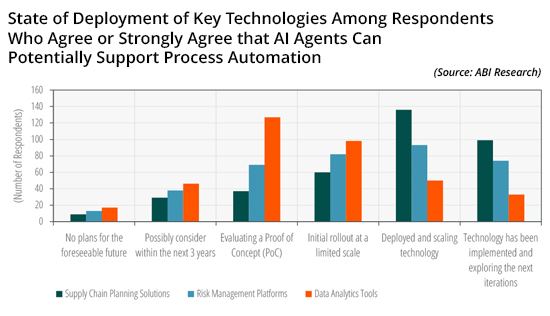
Executives currently in the Proof of Concept (PoC) stage or scaling up data analytics tools tend to see the greatest value in AI agents for process automation because these tools enable faster insights, predictive modeling, and anomaly detection across complex supply chain networks. Among executives whose work is data-driven, AI agents can automate repetitive data aggregation and create a lot of value. Cleaning large datasets and triggering real-time alerts can accelerate decision-making during early adoption and scaling phases.
Similarly, among organizations where supply chain planning solutions are already deployed and fairly mature, planners are increasingly looking to automate planning-based processes such as demand forecasting, inventory optimization, production scheduling, and capacity planning. By embedding AI agents into these workflows, organizations can see the value that can enhance their operations—a reduction of manual intervention, improvement in forecast accuracy, and the ability to adjust plans in response to market volatility, ultimately driving resilience and efficiency across the supply chain.
The "So What?" for Solution Providers
|
RECOMMENDATIONS
|
As this recent surge in AI agent announcements signals a new competitive phase, differentiation will depend less on who has agents and more on how they drive measurable impact. This will depend on their ability to integrate across ecosystems and enhance planner confidence as enterprises move from predictive analytics to autonomous orchestration. Solution providers must now shift their focus toward usability, interoperability, and domain depth to ensure sustained adoption and trust.
- Move from Feature Launches to Outcome-Centric Value: Vendors must not position their AI agents as standalone "add-ons," but as enablers of tangible business improvements such as reduced lead times or fewer disruptions. Quantifiable Return on Investment (ROI) tied to specific use cases will move the needle for buyers.
- Prioritize Seamless Cross-Platform Interoperability: Nearly all supply chains run hybrid ecosystems that mix Enterprise Resource Planning (ERP) and analytics platforms from multiple vendors. Vendors must recognize this and design agents with open Application Programming Interfaces (APIs) and cross-platform orchestration in mind. Vendors must also recognize that the next competitive edge won't come from who has AI agents, but from how well they integrate across various tools. Collaborative agent ecosystems will accelerate adoption far quicker than proprietary silos.
- Empower Human-AI Collaboration: Although automation is the core premise of digital workers, decision confidence still depends on human oversight. In addition, organizational inertia and fear of replacement might also come into play, given current market conditions. Vendors should emphasize "co-pilot" models where agents assist planners with context-aware recommendations, scenario generation, and exception handling while ensuring full auditability and explainability.
- Invest in Domain-Specific Intelligence: Generic AI won't be enough for hyperscalers like Google and Microsoft, and ERP giants like SAP and Oracle. There is a need to train agents on high-quality, supply chain-specific data, including supplier reliability metrics, logistics performance, production constraints, and external risk signals. Partnering with data providers and specialists will allow them to deliver more contextually intelligent and adaptive agents. It is very likely that domain mastery and data depth will be the key differentiator.