A Hectic Week—Two Newly Released Products Set to Shake up the LLM Landscape
|
NEWS
|
In August 2025, OpenAI released gpt-oss on Hugging Face, an open-weight release designed for powerful reasoning, agentic tasks, and versatile developer use cases. It currently includes two models: a larger one with 117B parameters (gpt-oss-120b) and a smaller one with 21B parameters (gpt-oss-20b). gpt-oss uses a Mixture-of-Experts (MoEs) model that improves performance by dividing tasks, enabling fast inference while reducing resource consumption. The gpt-oss-120b model can fit on a single H100 Graphics Processing Unit (GPU), while the gpt-oss-20b can operate within 16 Gigabytes (GB) of memory, making it suitable for consumer hardware and on-device applications. Three days later, OpenAI also announced its most advanced model, GPT-5. It features a unified system architecture that efficiently switches between a fast, lightweight model for routine tasks and a more comprehensive reasoning model for complex problems.
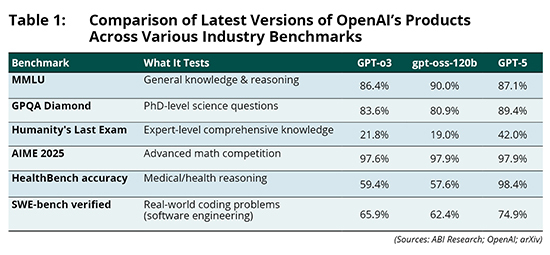
OpenAI presents oss as a highly customizable product secured by industry-leading permissive licensing. This allows users to adjust many aspects of their model, including reasoning effort, to low, medium, or high levels. gpt-oss and GPT-5 outperform their o3 predecessors significantly, representing another step forward in improving the intelligence of Large Language Models (LLMs).
A Two-Pronged Market Coverage Strategy
|
IMPACT
|
OpenAI’s gpt-oss entry into the highly competitive open-source market is very impactful. As one of the leading companies in AI development, it has kept its models and development exclusively proprietary for the past 6 years, resisting sharing its models with the open-source community, unlike other key competitors like Meta’s Llama, Google’s Gemma, DeepSeek, and Alibaba’s Qwen. The company’s recent strategic move into the open-source community could possibly shape future directions for LLM and foundational model deployment.
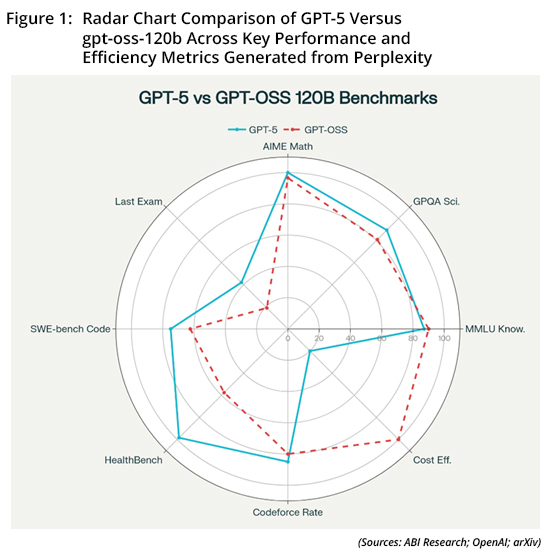
For the open-source community, the tech leader’s entry signifies a significant validation of the open-source approach. By making its previously proprietary models open for developers to experiment with and modify, OpenAI could speed up innovation cycles by sharing its research and democratizing its advanced capabilities. This release forces other major players to rethink their open-source strategies. Google, Meta, and Anthropic must now compete with OpenAI's open-weight models that perform on par or better in key benchmarks. This creates a race to reduce costs, while raising the performance standards for open-source models.
For the closed-source ecosystem, GPT-5’s launch quickly pressures basic AI capabilities. Proprietary providers must now justify higher prices through advanced features, better support, or specialized capabilities, rather than just performance advantages. These forces lead to vertical specialization, with proprietary models focusing on specific high-value applications like healthcare, finance, or legal work, while open-source models handle general-purpose tasks. As a result, the market becomes split—with premium, specialized solutions yielding high margins, while basic, commoditized solutions will compete mainly on price and customization.
Enterprises Must Revise Their AI Strategies and Understand Each Ecosystem's Value to Maximize ROI
|
RECOMMENDATIONS
|
With the simultaneous release, massive infrastructure investments could be underway as enterprises prepare for possible hybrid deployment models. The core advantage of hybrid deployment lies in intelligent workload distribution that matches computational requirements with optimal infrastructure. Organizations that adopt hybrid methods could implement real-time processing applications to achieve significant performance improvements through edge deployment, eliminating network latency costs, while reducing bandwidth requirements. Meanwhile, development and testing environments can utilize cloud subscription models, avoiding the Capital Expenditure (CAPEX) of dedicated development infrastructure.
From ABI Research’s perspective, the AI market is expected to evolve toward a three-tiered structure, namely: 1) premium proprietary solutions for mission-critical applications, 2) enterprise-grade open-source solutions for high-volume standard applications, and 3) hybrid orchestration platforms that optimize across both.
In the short term, an enterprise seeking to employ the hybrid deployment strategy should pilot and explore open-sourced models to offload non-critical applications. This enables them to understand deployment requirements, performance characteristics, and cost implications, which could provide strategic optionality without disrupting production systems. Additionally, in the long term, they must develop clear frameworks for choosing between maximum performance (proprietary models) and maximum control (open-sourced) based on specific use cases that consider data sensitivity, compliance requirements, cost constraints, and performance needs.



