Microsoft Is Leading the Way through Collaboration with Verticalized Independent Software Vendors
|
NEWS
|
Generative Artificial Intelligence (GAI) has taken the market by storm with significant consumer activity, but many questions remain concerning what market entry strategy GAI vendors should pursue to drive enterprise adoption. In recent weeks, Microsoft began to signal its commercial intent with the announcement of multiple strategic collaborative partnerships aimed at integrating OpenAI services with existing vertical-specific software platforms:
- Microsoft and Epic: A co-innovation initiative aims to integrate GAI into Epic’s Electronic Health Records (EHR) software to optimize employee processes, including automated patient on-boarding, prescription drafting, and automatic patient message responses. This solution is already in a Proof of Concept (PoC) in the United States with UC San Diego Health, among others, deploying enhancements to automatically draft message responses. In addition, integrating with SlicerDicer, Epic’s self-service reporting tool, will aid clinal data exploration and trend evaluation.
- Microsoft and Siemens: Converging Microsoft’s Teams platform and OpenAI service language with Siemens’ Teamcenter software will optimize product design, engineering, manufacturing, and operations. Deploying GAI across each operational workflow, particularly software development, problem reporting, and visual quality inspection will reduce manual operations and drive operational efficiencies across manufacturing processes. This is an extension of their partnership, which previously focused on edge AI vision models for product inspection/quality control.
On the other hand, competitors like Amazon Web Services (AWS) and NVIDIA are pursuing a more horizontal, platform approach to this opportunity. They are providing foundational models, developer tools, and cloud resources to enable enterprises or third-party developers to build enterprise-ready GAI services. AWS announced Bedrock, a cloud service that makes foundation models (Amazon Titan, Claude, Jursassic-2, Stable Diffusion) available to customers via Application Programming Interfaces (APIs). NVIDIA has followed a similar approach through DGX Cloud, a platform that combines software (including NeMo, Picasso, and BioNeMo), hardware, and expertise to enable a vertical-agnostic GAI deployment.
Which Strategy Will Be More Effective?
|
IMPACT
|
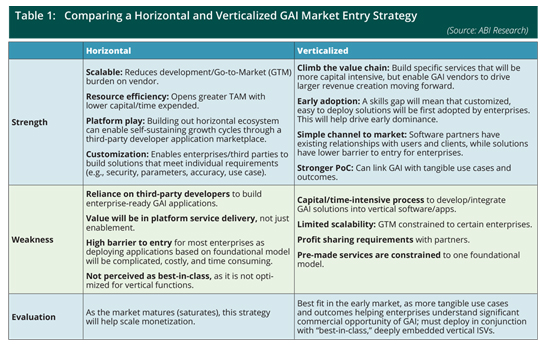
Microsoft is widely viewed as a market leader, but will a verticalized market entry strategy be the most effective? Table 1 explores the strengths and weaknesses of both strategies before providing an evaluation.
How Can GAI Providers Choose the Right ISV Partner?
|
RECOMMENDATIONS
|
Given the stage of the market, ABI Research believes that Microsoft’s highly verticalized strategy will be most effective. But making this work requires a strong ecosystem of partners. So, what do providers deploying this strategy need to look for in a vertical ISV partner:
- Software Maturity: Deeply embedded software platforms with strong ecosystem integration will provide the foundation for strong GAI market entry; in addition, integration with “best-of-breed” software platforms will give GAI apps credibility and enhance customer assessment.
- High Vertical Penetration Rate: Vertical partners should provide a strong channel to market for future revenue creation through existing relationships, as well as instant revenue by offering GAI deployment for existing software subscribers through updates.
- Product Alignment: GAI deployment should not be an afterthought; it should be aligned with the vertical software value drivers to enhance the software solution’s value proposition. GAI providers should be careful to partner and deploy for value-driven use cases.
- Openness to Co-innovation and Co-marketing: Beyond the software platform itself, to extract maximum commercial value, partners must be closely aligned on a wider strategy, which should include marketing, messaging, and customer engagement.
ISVs will play a large role in GAI enterprise commercialization, but what does this mean for them? Well, the good news is that they could play a significant role in a transformative market and by integrating GAI, they will significantly enhance their value proposition without huge investment. This will spur further enterprise usage and more extensive relationships with clients. In addition, hyperscalers will be reliant on this software as a market entry point, shifting the balance of power ever so slightly in favor of the ISV.
But the news isn’t all good, especially for software vendors not able to partner quickly. Beyond PoC partnerships, hyperscalers will not continue to shoulder the burden of investment and deployment; instead, vendors will have to pay to integrate GAI solutions into their software. This will be hugely costly and create another competitive dimension. So, ABI Research recommends that ISVs act quickly to ensure that they can benefit from the first PoC wave and more cost-effectively embed GAI into their software platform.



